

What this really points out is that some law enforcement officers are mentally deficient, as they lack the ability to verify if the AI match was accurate in the first place before proceeding. And to make it worse, some know the ALPR cameras get license plates wrong and they’ll input different tags without checking to see if the different tag belongs to someone else. And the fact people who obviously are not the one they’re looking for end up arrested and in jail is unacceptable, and going to end up a serious financial drain on the municipality when they settle the wrongful arrest and imprisonment lawsuit. And having watched a lot of police videos, some law enforcement agencies have seriously unprofessional and under trained officers with possibly the exception of state police, with the gold standard being the Arkansas State Troopers. And the worst law enforcement agency is the FBI who railroads people, trumping up charges to coerce a plea bargain from people who are innocent… which is a purposeful due to financial bonuses to managers, not to mention using criminal informants to entrap gullible people into conspiracies that can be exploited in the press for budgetary concerns… So it’s best to know your rights, exercise your right to silence and get an attorney when dealing with substandard law enforcement, especially when you can do prison time for giving a false statement to federal agents who can lie in their reports. And just look at how they’re currently trying to railroad the young man for the Jan 6th bombing when there is video evidence it’s not him, and by all accounts it looks like they duped an agent into planting the training bombs for an exercise as part of the Jan 6th conspiracy against the protestors, as they didn’t follow proper procedures in handling the bomb giving away they knew it wasn’t a threat…
https://reclaimthenet.org/kentucky-facial-recognition-arrest-lawsuit
A blurry algorithmic hunch became a warrant, a jail cell, and now a federal lawsuit.
By Ken Macon
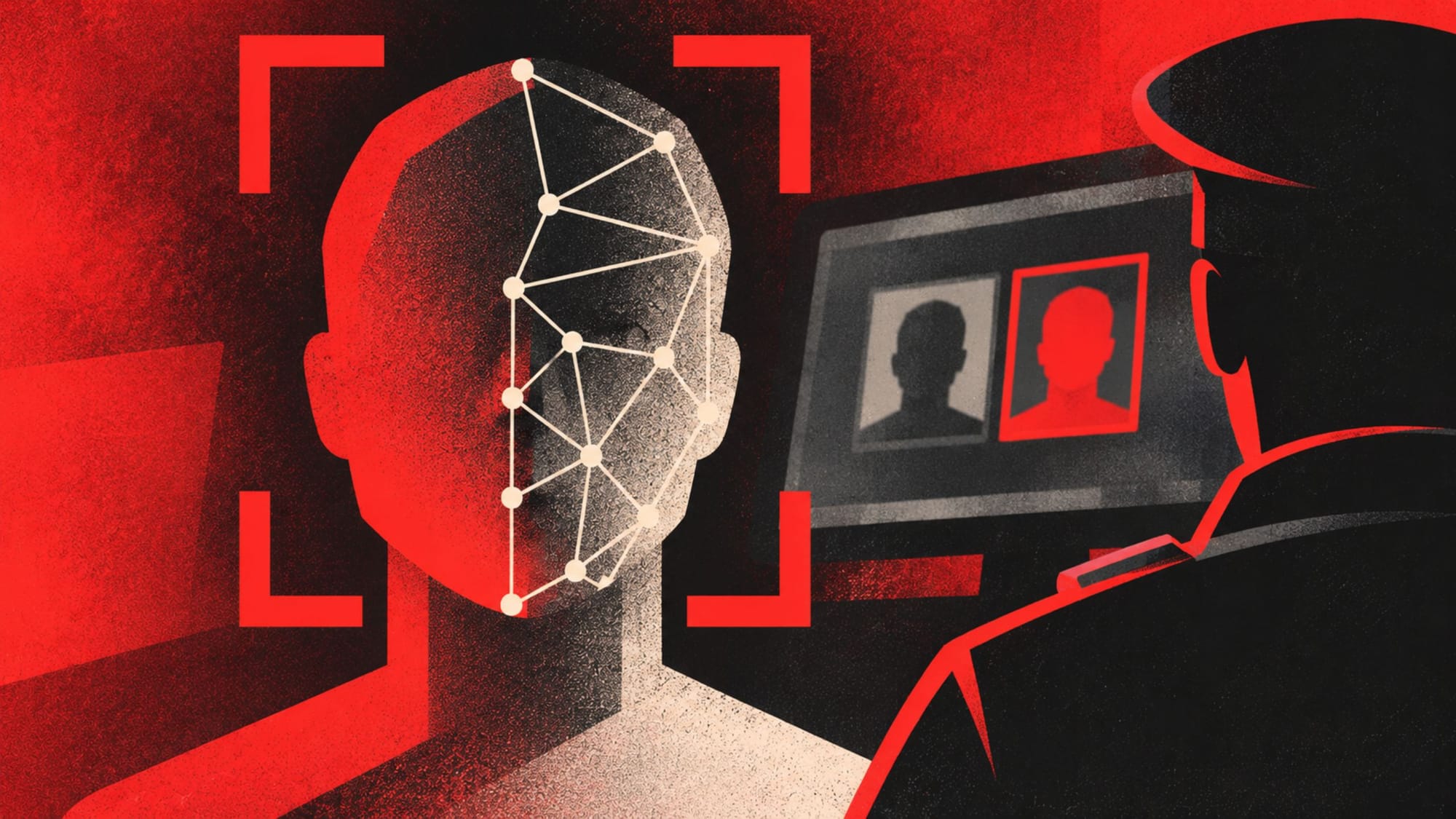
A federal judge in Kentucky has allowed a man to sue a police detective whose use of facial recognition led to the man spending 16 days in jail for a crime he did not commit.
US District Judge S. Chad Meredith, of the Eastern District of Kentucky, on November 9 refused Detective Ryan Kilmer’s motion for judgment on the pleadings and denied him qualified immunity at this stage.
“The Fourth Amendment to the United States Constitution does not allow a detective to delegate to AI the task of assessing probable cause,” Meredith wrote in his opinion, adding that it does not permit an arrest “based on nothing more than an uncorroborated conclusion by AI that the individual in question has committed a crime.”
The case started with a man trying to cash a $6,200 check at a bank in Florence, Kentucky, using a fake Texas driver’s license. The teller refused and the man left with nothing, but the bank’s security camera captured his face. The detective took a screenshot of that face and ran it through a facial recognition system, which produced a match against a booking photo and a Facebook profile picture.
The social media profile belonged to “Yony Smith Npoles Charon” – but the detective decided, “for an unknown reason,” that this was actually Alain Vizcay Osorio, the man in the booking photo. The complaint says the two men “look nothing alike and are clearly two different individuals.”
The complaint said that “it is still not clear how or why Detective Kilmer concluded Yony Smith Npoles Charon and Alain Vizcay Osorio to be the same person.”
The detective’s affidavit for the arrest warrant said that “using investigative tools” he had found a booking photo that matched the bank security footage. The only “tool” was the facial recognition system, and the warrant application did not mention it, Osorio alleges. According to the opinion, the detective “used only one notoriously unreliable tool” and did not disclose it.
The Florence Police Department’s own policy says that facial recognition is “advisory” and does not “establish probable cause without further investigation.”
Meredith wrote that there was “good reason to think that the warrant would not have been issued” had the detective “painted a full picture of how he arrived at the conclusion that Osorio was the individual who attempted to cash the fraudulent check.”
The attempted fraud took place on August 30, 2024, while Osorio was at work in Nebraska. He was arrested on January 9, 2025, in Florida, extradited to Kentucky, and held for 16 days before he was released on bond. In March 2025 he was indicted on two felony counts, only for the prosecution to drop the case two months later.
The complaint said that the detective “made no effort, prior to issuing the arrest warrant, to determine Alain Vizcay Osorio’s whereabouts at the time of the offense.”
The judge used a hypothetical scenario to explain his reasoning, involving a detective who uses a Magic 8 Ball to pick suspects by shaking it at people passing by, getting the answer “You may rely on it” for one of them, and then writing in his affidavit that he used “investigative tools.”
“A Magic 8 Ball alone will not cut it,” the judge wrote, adding that while facial recognition “is likely more reliable than a Magic 8 Ball,” putting “unquestioned reliance” on it “is still not much different in principle from placing unquestioned reliance on a Magic 8 Ball.”
The detective argued that Osorio could not point to a previous case where relying solely on facial recognition was found to violate the Fourth Amendment. The judge said the case was obvious enough not to require a previous ruling, “especially given how Osorio’s booking photo looks nothing like the suspect from the security camera footage.”
The judge noted that “Of course, discovery might show that there is more to the story than the Plaintiff alleges” and that “Things might change in light of discovery.”
Kilmer denies any wrongdoing, while Osorio’s claims include false arrest and malicious prosecution under federal law, as well as Kentucky state law claims. The detective has 14 days to respond, and a status conference is set for November 19.
This is not an isolated incident, either. In April, Reclaim The Net reported about Jason Killinger, who was flagged by a casino’s system as a “100 percent match” for a banned man, and spent 11 hours in custody, only for the arresting officer to later admit under oath that the arrest “never should have happened.”
In March, we reported about Angela Lipps, a Tennessee grandmother who was jailed for 108 days over a bank fraud in Fargo, North Dakota, that she could not have committed – until her bank records proved it.
“I’ve never been to North Dakota, I don’t know anyone from North Dakota,” Lipps said.
In 2022, Randall Reid was arrested in Georgia on a Louisiana warrant that was issued after a facial recognition match.
“I have never been to Louisiana a day in my life,” he said.
Porcha Woodruff was arrested in Detroit while eight months pregnant, and in 2020 Robert Williams was arrested in front of his family, also in Detroit. In each of these cases, the person wrongly matched had to prove their whereabouts at the time of the crime, instead of the police proving their case.
The real problem with the Kentucky case is not that the detective ignored his own department’s policy and treated the facial recognition match as the only investigative tool he needed. It is that the search itself is highly problematic, as it effectively puts every face that is on social media into a police lineup, and lets them fish for a match. A rule that says they can’t rely solely on the result does little to change this disturbing reality.