

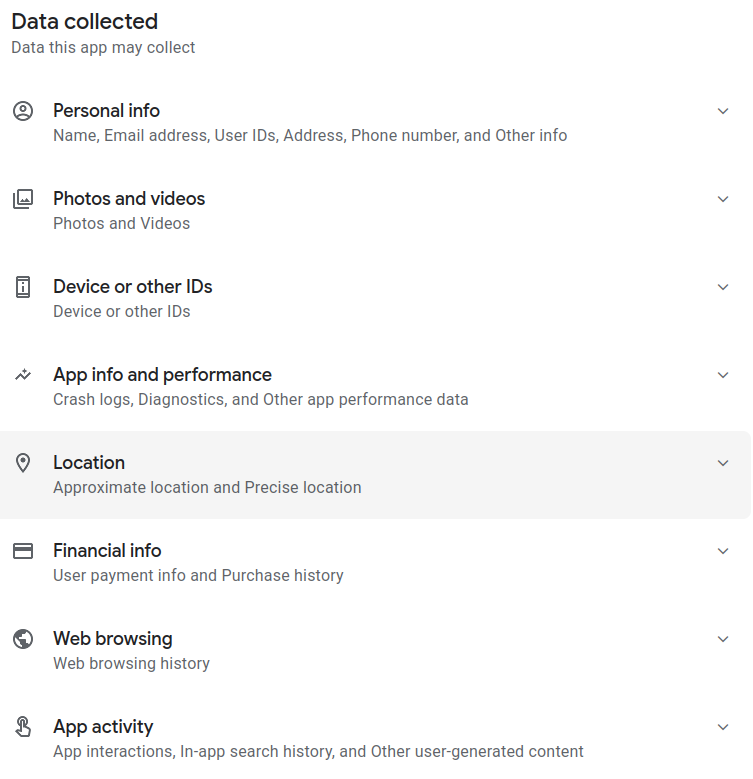
(Headline article below) I don’t remember the last time I had a coffee from Charbucks, but it’s been well over a decade, maybe two (I value good coffee and roast my own coffee picking a roast level below charred to death used for shelf life). And today in most areas there are better coffee shops, and even Buc-ee’s coffee is better. When I was working about a decade ago, coworkers were all using the app on their phones to order and go pickup Starbucks, and I’d imagine Starbucks collects a lot of data. Let’s see, and nope, wouldn’t make the cut for installing on my phone.
It kind of sounds like they’re thinking of utilizing facial recognition as determining vehicle wouldn’t be enough because families can share vehicles. And remember that a lot of businesses want you to film a selfie of your face as you turn it slightly side to side for their facial recognition data gathering, and I won’t believe otherwise regardless of what they say. No thank you to any business that wants to violate my privacy like this.
https://reclaimthenet.org/starbucks-customer-recognition-drive-thru-surveillance
The coffee run is becoming a small, highly optimized audition for the surveillance economy.
By Ken Macon
Starbucks wants its drive-thru to know who you are before you order, the company’s Chairman and CEO Brian Niccol revealed during the coffee giant’s fiscal fourth-quarter earnings call.
He said Starbucks is “exploring experiences that recognize participating customers as they arrive, present personalized digital menus, and make payment more effortless.”
Niccol added, “We’re early in this work, and we’ll test, learn, and scale what works.”
This is not the first time the company has shown interest in “recognizing” its customers in its physical locations. In 2023, it was trialling Amazon’s palm payment system, Amazon One, in a store in Edmonds, Washington. And in New York, Amazon and Starbucks got sued for collecting biometric data via cameras and sensors.
Now it’s the drive-thru’s turn, and the idea is to “recognize” customers as soon as they pull in – but it’s unclear what technology will be used to do that. The company has not disclosed whether it would be the app, an account signal, a phone, a license plate, a voice, or a face.
Nor has Starbucks said where it plans to test this, how it plans to obtain consent from those who will be “recognized” in this way, whether customers will still be able to use the drive-thru without being profiled in this way, or how long their data will be kept.
All we know is that Niccol said, “Roughly half of our customers use the drive-thru, making it a significant opportunity” that the company wants to make “faster, more convenient, and more personal.”
The word “participating” in the context of “experiences that recognize participating customers” suggests that this will be an opt-in scheme, but it is not yet clear what this will mean in practice.
When an analyst asked for a timetable regarding this project, the company replied, “It would be premature to get specific on this.”
Starbucks is also looking to unlock “more personalized touchpoints through relevant content and recommendations tailored to customer tastes and preferences” via its app, and is counting on AI “with the potential to support conversational and agentic ordering over time.”
In fiscal 2027, the company will begin testing “background AI models in the drive-through that help our baristas input orders more accurately and efficiently as they interact with customers.”
Starbucks said that its loyalty program, Starbucks Rewards, now has a record 36 million 90-day active members, and that the next step is “going to be more around additional personalization.”
The reason is this – “If you can improve throughput, a lot of good things happen from there, both on the top line and bottom line.”
In the past, customers who were “freaked out” by biometric payments were older people, an attendant at the 2023 pilot in Washington said.
The lawsuit in New York was filed over the use of Amazon’s Just Walk Out cameras and sensors that track customers as they pick up items, and are supposed to charge them for these when they leave the store. The plaintiffs’ attorney said at the time that people should be able to “decide for themselves whether they want to provide measurements of the size and shape of their body as a condition of getting a sandwich.”
When you link a car pulling into a drive-thru with a loyalty program, an order, payment, and preference data, a simple stop for coffee becomes a logged visit: when you come, what you buy, and which suggestions you respond to by spending more.