

The thing that betrays these kinds of efforts really designed to bring about identifying every internet user, is the fines per incident, usually $7,500, but these political hacks want $50,000. They’re working by state to make such a mess with differing requirements that a national digital ID becomes palatable to citizens, they hope. And if you don’t identify, you’ll be locked into these dumb teenage restrictions. And the operating system requirement will never fly with opensource software. Just don’t use platforms that do this, most of which are harmful to you and your privacy anyway.
https://reclaimthenet.org/florida-wants-to-put-an-age-gate-on-the-entire-internet
Florida banned kids under 14, took Meta to court, and went after ChatGPT. Now it wants the phone itself to check your age.
By Dan Frieth
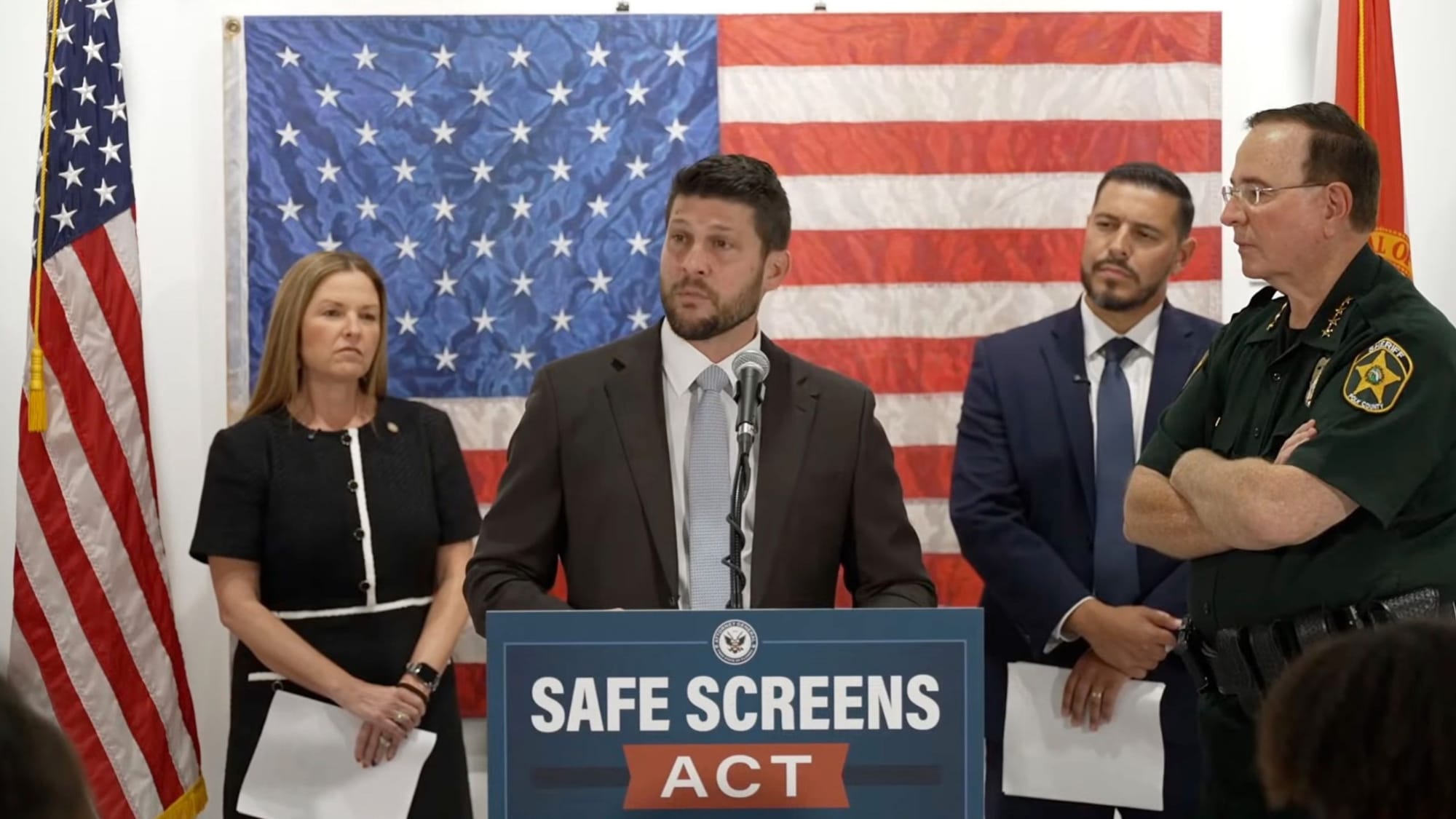
Florida Attorney General James Uthmeier has announced a legislative proposal that would bring age verification to the app store, the operating system, and AI chatbots.
The announcement was made at Polk State College in Winter Haven, and Uthmeier was joined by Polk County Sheriff Grady Judd and education leaders.
Under the proposal, app stores and similar marketplaces would have to “determine the user’s age, link minors to a parent’s account, and obtain parental consent before a minor downloads or buys an app from a covered platform.”
In addition, the operating systems would have to “apply age-appropriate restrictions at the device level based on the user’s age,” while AI chatbot operators and platforms “must determine account holder’s age.”
The proposal, that has not yet been turned into a bill, is full of invasive promises, including that “all age determination must use commercially reasonable, privacy-protective methods,” as if that’s possible.
However, no method is named, and this is the same promise made with most age-check laws, while reports of identity document leaks keep showing that the promise is not being kept. As Reclaim The Net reported in April, Discord’s earlier experiment with government ID age checks ended in a massive breach that exposed over 70,000 government-issued IDs.
Other provisions of the proposal include forcing social media accounts of those aged 14 to 17 to have a “quiet mode” that blocks access from 11 pm to 7 am, and from 8 am to 3 pm on school weekdays. The release says, “Muting notifications is not enough.”
For the same age group, screen time would be capped at two hours a day and 60 hours a month, “including messaging and long-form content.” Like counts would be hidden, autoplay and infinite scroll would be off unless a parent turns them on, and cosmetic filters would be disabled. Teen accounts would not be recommended to unconnected adults, who may not message them. Every three days, teens would get a prompt to switch to a non-personalized feed that they cannot dismiss.
Reports of child sexual exploitation would get human review within 48 hours, with a “one-strike” rule for adult offenders.
AI chatbots would not be allowed to offer minors features that “simulate companionship through personification, emotional engagement, user-data retention, unsupervised therapy, sexual content” or ones that “suggest the chatbot is a real human” or “encourage isolation or discourage help from appropriate adults.”
The press release said that knowing or reckless violations would be considered unfair practices under Florida Statutes section 501.1736, and would carry a fine of up to $50,000 per violation. The AG’s office would also be able to “maintain a public website to track incidents.”
Uthmeier said, “Parents deserve real control, and companies must design for safety, not addiction.” He also noted that “Florida already prohibits social media accounts for anyone under 14, and the Eleventh Circuit just upheld that law. The Safe Screens Act goes further.”
“If you invite Florida’s children onto your platform, you have a duty to keep them safe,” he also said.
Judd, meanwhile, praised the proposal, saying, “It takes the power and determination of an Attorney General to keep large social media and gaming companies from exploiting and endangering our children.”
State Rep. Jennifer Kincart Jonsson, a Republican from Lakeland, said, “Technology is changing faster than ever and we have a responsibility to make sure our laws keep up.”
The new proposal was announced by the state’s Attorney General, who cannot actually file a bill – that would have to be done by a member of the Florida House or Senate, and there has been no word on that yet. The 2027 legislative session is set to start on March 2.
Uthmeier faces reelection in less than two weeks, while his Democratic challenger, former state Sen. Jose Javier Rodriguez, reacted to the announcement by saying, “Florida families deserve an Attorney General who understands that protecting children matters more than political headlines.”
Meanwhile, the Eleventh Circuit ruled on October 14 that HB 3 is likely constitutional and threw out the injunction that had been blocking it. The law bans those under 14 from covered platforms and requires parental consent for those aged 14 and 15.
The court said the law works “not as an outright prohibition of platform usage but rather as a ‘conditional ban’ of sorts.”
However, the Computer and Communications Industry Association (CCIA) President Matt Schruers said the decision “risks imposing identity authentication on Floridian internet users of all ages.”
In her November 2025 dissent, Judge Robin Rosenbaum wrote that the law “effectively requires linking users’ identities (not to mention their parents’ identities) with users’ social media accounts.”
Reclaim The Net reported on October 8 that Uthmeier asked a court to order Meta to check the ages of its Florida users. The state opted out of the multistate settlement with Meta, with Uthmeier saying at the time, “Meta tried to get us to take their low-ball settlement, but we won’t sell out our kids.”
At the end of September, the AG asked a court to order OpenAI to implement “a robust and effective age verification system” for ChatGPT.
On October 16, Discord was sued for allegedly not scanning private messages thoroughly enough.
Each of the previous three lawsuits Uthmeier filed asked a court to order one company to implement age checks. But this proposal would write age verification into the phone itself – and the store every app comes from.
To find out who the minors are, you have to check everyone.
There is currently no text of the proposed bill, no information on what platforms would be covered, or what “privacy-protective” method would be used for age checks.