

It’s funny the liberals get bent out of shape with Flock helping ICE, but no concern for the privacy of actual citizens. And this behavior of Flock not removing the cameras until the contract was up, and even removing the plastic bags, kind of points to the university not being the actual customer. And are these included in a task force linked deal with the data uploaded to third party servers?
Elgin Community College resorted to covering the surveillance cameras with trash bags and zip ties. Public records show that federal immigration authorities have accessed Flock data at other Illinois colleges.
By Lisa Kurian Philip Oct 9, 2026, 4:30am MDT

When Elgin Community College hired Flock Safety to install six surveillance cameras in April 2025, President Peggy Heinrich thought they would “enhance the safety and security of students.”
The company’s automatic license plate readers use artificial intelligence to track the registration, model and details like dents and bumper stickers of every passing vehicle. They were supposed to help locate stolen cars and missing people.
But Heinrich started to wonder if the cameras were actually making students less safe after seeing news reports that data captured by Flock cameras in Illinois had been shared with U.S. Customs and Border Protection. Then in September 2025, Immigration and Customs Enforcement detained an Elgin Community College student in a campus parking lot.
More than half of students at the far west suburban Chicago campus identify as Latino. Heinrich said enrollment dipped. Students were afraid to come to class. College officials decided the cameras had to go.
“We’re just doing everything we can here to be sure this feels like a safe place for our students to come,” Heinrich said. “We want them to come here and to be able to focus on learning.”
As concerns about Flock and other makers of automatic license plate readers continue to emerge, students and educators across Illinois are calling on college leaders to terminate their contracts with the company. They say the surveillance technology violates student privacy and endangers immigrant students and student activists who’ve been targeted by the Trump administration.
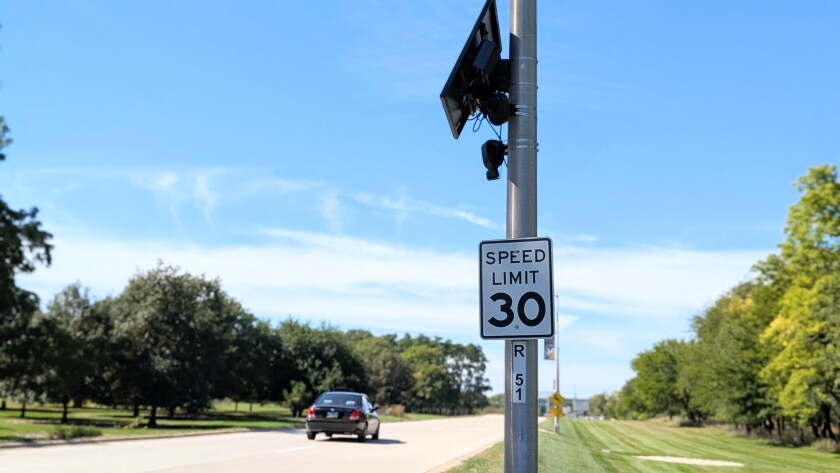
Public records obtained by surveillance researcher Torin Monahan and WBEZ show that data captured by Flock cameras at other Illinois public campuses, including Joliet Junior College, the University of Illinois Chicago and the University of Illinois Urbana-Champaign, was searched dozens of times last year in connection with immigration enforcement. In some cases, federal immigration authorities directly accessed colleges’ data. The Illinois Secretary of State also found that U.S. Customs and Border Protection searched Illinois Flock data last year in violation of state law.
Heinrich said her staff audited the campus’ Flock data and found no evidence to suggest it had been accessed by federal immigration agents. Still, college officials asked Flock to remove the surveillance cameras “out of an abundance of caution for our students,” Heinrich said.
But getting the cameras taken down was not as simple as it sounds, especially because Flock retains ownership of the company’s equipment. Flock responded to Elgin Community College’s request with silence — and even resistance.
Flock Safety did not respond to WBEZ’s request for comment. The company has said federal agencies, including Immigration and Customs Enforcement, can no longer access local Flock data unless law enforcement agencies grant access.
Surveillance experts say the company is financially incentivized to have as many cameras gathering data as possible even in places that no longer want them, because potential clients are looking for the surveillance network with the greatest reach.
“You get to access even more cameras throughout the country,” said Monahan, a professor at the University of North Carolina Chapel Hill.
Elgin Community College staff notified Flock in October 2025 that they wanted to cancel their contract and have the cameras taken down. Within a day, Heinrich said, Flock rejected the request and refused to uninstall the equipment on the basis that the company had not breached their agreement.
College officials reached out again in December 2025 and said they would pay for the remaining five months of the contract — they just wanted the cameras taken down.
“We never received a response back from Flock,” Heinrich said.
That’s when things got weird. Heinrich said Elgin Community College staff began to cover the cameras using black trash bags and zip ties so that they would not be able to capture footage. But workers in an unmarked vehicle, which Heinrich assumed belonged to Flock, repeatedly removed the coverings.
“We were kind of in a back and forth for a bit where we’d cover, and then when they’d come to service, they’d remove,” Heinrich said. “Then we’d cover and then they’d remove.”
This strange dance continued, Heinrich said, until Elgin Community College’s contract with Flock expired in April this year and the company uninstalled the cameras for good.
Flock cameras can undermine efforts to make students feel welcome
But public records show Flock’s license plate readers are still installed at several other colleges across the state, including at five of the state’s 12 public universities and at four community colleges.
That’s the case at southwest suburban Joliet Junior College. At the main campus entrance, which is bordered on one side by cornfields, students like Lui Rodriguez have to pass at least one of the college’s seven Flock cameras to get to class.
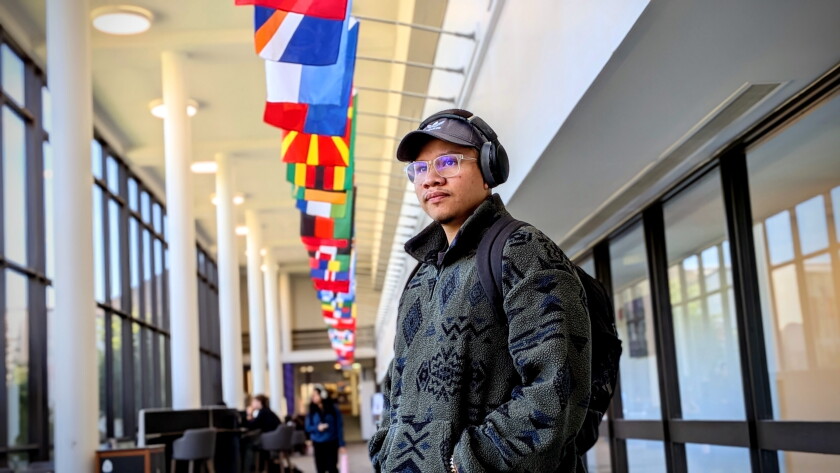
A third of students who attend Joliet Junior College, including Rodriguez, identify as Latino. The 26-year-old said the staff goes to great lengths to make students feel a sense of belonging. Rodriguez has even baked cookies with the dean of students to raise funds for the student group Latinos Unidos.
“The staff here care about the students,” Rodriguez said.
So Rodriguez was shocked when he found out that Joliet Junior College contracts with Flock — and that public records show data captured by cameras on campus was directly accessed by federal immigration agents last year.
“It’s kind of like a backstab to the students,” Rodriguez said. “I wish more people knew about it.”
Katie Smith, a spokesperson for Joliet Junior College, said college leaders and campus police proactively review who has access to their Flock data and would take any misuse of this information seriously. The college’s contract with Flock is up for renewal in July 2027.
“The College remains committed to fostering a welcoming and inclusive environment for all students and staff while balancing its responsibility to provide a safe campus environment,” Smith said in a written statement. “The safety of our students and the broader campus community is paramount.”
But Rodriguez said those reassurances, and the Flock cameras, do not make him feel safer on campus.
“We’re being surveilled and our information can be used to track us down and detain us,” Rodriguez said. “That’s not conducive to education and learning.”