

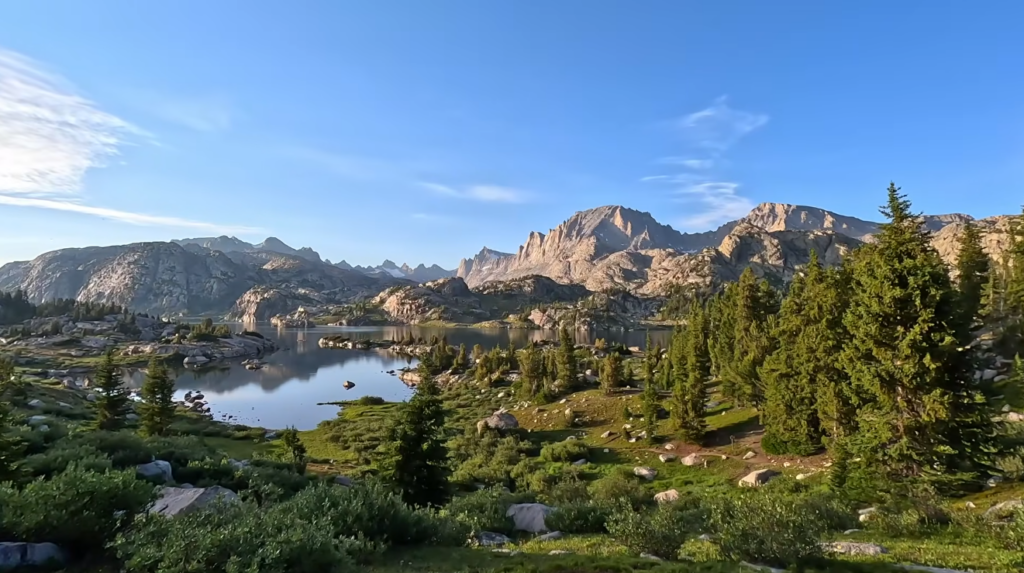
I watched the YouTube video below on a hike to Island Lake in the Wind River Range of Wyoming, and I was blown away by the view, which is much more impressive on your big screen TV. Definitely a backpacking trip as it’s about 12 miles in. He had another interesting WRR trip video worth a look, as you could see the Grand Tetons as well as the tallest peak in Wyoming..
https://trailwalkertravels.com/backpacking-island-lake-in-the-wind-river-range/
Guide to Backpacking Island Lake in the Wind River Range
After seeing my photos on social media, many people have asked me to write about my adventure backpacking Island Lake in the Wind River Range. So here is my guide to this stunning area.
Table of Contents
- Trail Overview – Backpacking Island Lake in the Wind River Range
- Getting There: Elkhart Park/Pole Creek Trailhead
- The Detailed Trail Breakdown to Island Lake
- Camping at Island Lake Wind River Range
- When to Go and What to Bring
- Safety in the Wind River Range
- Capture the Moment
- Leave No Trace
- FAQs about Backpacking Island Lake in the Wind River Range
This post may contain affiliate links to trusted partners. If you purchase through these links, I earn a commission at no extra cost to you. Thank you for your support!

Trail Overview – Backpacking Island Lake in the Wind River Range
Below are the trail stats I recorded (Alltrails was a little off from mine).
- Distance: 24.6 miles round trip
- Elevation: Starting at 9,340 feet, topping out at 10,410 feet (with plenty of ups and downs)
- Total Elevation Gain: 3,630 feet
- Difficulty: Strenuous (This is a tough one)
The trail has a lot of ups and downs. It’s a workout, but the payoff is massive.
Getting There: Elkhart Park/Pole Creek Trailhead
Your hike begins at the Elkhart Park/Pole Creek Trailhead. From Pinedale, Wyoming:
- Head east on W Pine St for 0.3 miles
- Turn left onto Fremont Lake Road
- Follow it for 14.3 miles (it becomes Skyline Drive)
- Turn right into the Elkhart Park/Pole Creek Trailhead parking area
- Google Maps is accurate
The Detailed Trail Breakdown to Island Lake
Here is the detail of backpacking Island Lake in the Wind River Range:
- Elkhart Park to Miller Park (3.3 miles): You’ll start in the forest. This is not the most exciting part but it will get better.
- Miller Park to Photographer’s Point (4.6 miles): Things start getting more interesting. You’ll hit some meadows and rock outcroppings. At Photographer’s Point, the views are stunning. It’s a sneak peek of more to come.
- Photographer’s Point to Seneca Lake Trail Junction (5.6 miles): The trail starts to show its true beauty. You’ll pass Eklund Lake and turn left onto the Seneca Lake trail.
- Seneca Lake Trail to Highline/Continental Divide Trail Junction: You’ll pass Barbara, Hobbs, Seneca, and Little Seneca Lakes. It’s beautiful, but it’s also where you’ll feel the elevation. Make sure you stay hydrated.
- Final stretch to Island Lake: After joining the Indian Pass trail, you’ll climb over a ridge and descend to a viewpoint that’ll have you pulling your camera out. Island Lake spreads out before you, with peaks like Mount Helen, Mount Sacagawea, and Fremont Peak in the background.

Camping at Island Lake Wind River Range
Here is my advice on camping:
- The further north you go, the more privacy you’ll find.
- Explore around the entire lake if you want a secluded spot most people tend to camp right when you reach the lake
- Do not camp within 200 feet of lakes and trails (this is policy)
- No permits are required at this time.
If you’re heading into Titcomb or Indian Basins for camping, remember you’re above treeline. It’s exposed, and finding spots 200 ft from water and trails can be tricky. Bring a bear canister – there aren’t many trees for hanging food.
When to Go and What to Bring
- The Best Time To Go Backpacking Island Lake in the Wind River Range:
- Late July to early September. Snow can be present in July and late September.
- Check the weather as mornings are typically cold and thunderstorms are common though short-lived.
- I went in early September and the weather was perfect and the mosquitos were minimal compared to my backpacking trip in mid-July to the Cirque of Towers in the Wind River Range, where they were voracious.
- Gear – Pack light but be prepared for changing weather. Below are a few items I would definitely bring:
- Water Filter – Grayl Geopress or lighter weight options Sawyer Squeeze
- Bear Spray – this is grizzly and black bear country.
- Mosquito Repellent and Mosquito Head Net (You will thank me!)
- Sattelite GPS/Communicator – I use the Garmin inReach 2
- Packable Daypack – If you are staying more than 1 day, have a home base and do day hikes. A packable day pack like this comes in at 2.5 ounces and is compact (fits in the palm of your hand when packed up).
- For a comprehensive backpacking checklist, sign up for my email list and get it free!
- When planning a backpacking trip, tailor your gear to your adventure’s specifics: consider the distance and terrain you’ll hike, the remoteness of your destination, and the expected weather. The checklist is comprehensive, but you won’t need everything on it. Use it as a guide to choose what fits your trip’s unique needs for a safe and enjoyable experience.
Safety in the Wind River Range
- Weather changes fast. Pack layers and rain gear.
- Tell someone your plans. Cell service is not available.
- Bring a satellite communicator for safety.
- Carry a first-aid kit.
- Carry bear spray.
- Make sure you have a water filter.
- Watch for signs of altitude sickness and make sure you are keeping hydrated.

Capture the Moment
For photographers:
- Sunset at Island Lake was my favorite time to shoot. The fading light hits the front of Fremont Peak (the main peak in the image above), creating a stunning alpenglow effect.
- There’s a hill behind the lake that is a perfect vantage point for capturing the entire lake with its surrounding peaks.
- Get creative with your campsite selection (while following Leave No Trace principles, of course). Find a unique spot so you can get your “tent in the wilderness” shot.
- Explore Titcomb Basin for more photo opportunities
- Don’t forget to pack your wide-angle lens for capturing the vast landscape.
A few recommended articles to get that perfect shot:
Photography Fundamentals: 9 Tips for Landscape Photographers
Capturing the Magic: 10 Tips for Better Sunrise and Sunset Photos
From Good to Great: 11 Editing Tips for Landscape Photography
Leave No Trace
This place is stunning. Let’s keep it that way.
- Pack out all trash (yes, even toilet paper)
- Use a trowel or wag bag
- Please keep it clean. No soap in lakes, even biodegradable.
FAQs about Backpacking Island Lake in the Wind River Range
- Do I need a permit? No permit is required for overnight stays but check current regulations.
- Are there bears? Yes, both black and grizzly. Carry bear spray and know how to use it.
- Can I have a campfire? Fires are prohibited in some areas. Check current fire regulations and always use established fire rings.
- Is the trail well-marked? Generally yes, but bring a map and compass (and know how to use them).
- Can I do this as a day hike? It’s possible if you’re in great shape, but you’ll miss out on a lot. Make it an overnighter if you can or more and explore this vast area.
Backpacking Island Lake in the Wind River Range is no walk in the park, but it’s an experience you’ll never forget. The challenge, the views, and potential photos – it’s all worth it. So pack that bag, and get ready for the adventure of a lifetime in the Wind River Range.