

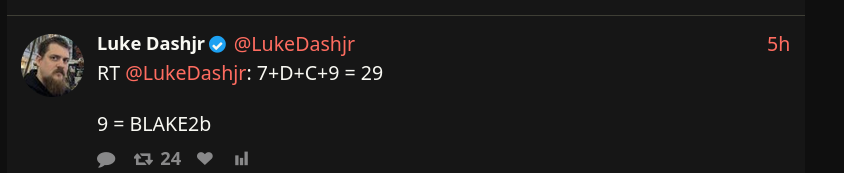
Good update on what’s going on in Bitcoin and the BIP-110 fork. I switched my Bitcoin nodes back to Bitcoin Knots 29.3 pre BIP-110 on the legacy chain after the soft fork stalled out and it was clear the miners betrayed us, so I’m all for the hard fork. So I ordered a 2 TB SSD for an unused Raspberry Pi 5 to support this hard fork. The new algorithm replacing SHA256 will be BLAKE2b (below). There is ASIC mining hardware as BLAKE2b has been used with other cryptocurrencies. Hopefully they do a clean fork per the Sep. 11th date as I’ve done some transactions since the soft fork stalled out and I reverted to the legacy chain. But we should have a mechanism to split out the chains so you have the same coins on both. To start, the Bitcoin Legacy suitcoiners will heavily dump the new hard fork coins and tank the price, and we’ll have to see where it goes afterwards. But with the centralization and capture of Legacy Bitcoin, there should be good support for the hard fork. Over time it might even takeover, and the bankers centralizing Bitcoin could crash it on purpose or by accident by going a bit too far and changing it against the will of users.
Blake2b Mining Algorithm: Speed, Security, and Efficiency Explained
1. History of Creation
- BLAKE2b emerged in December 2012 as part of the BLAKE2 family, conceived by Jean-Philippe Aumasson, Samuel Neves, Zooko Wilcox-O’Hearn, and Christian Winnerlein. It’s a refined successor to the original BLAKE (a SHA-3 finalist), optimized for higher speed and improved security. Notably, BLAKE2b tweaks the round function—removing constant additions, adjusting rotation constants, simplifying padding, XORing a parameter block into IV, and cutting rounds from 16 to 12—enhancing efficiency without compromising cryptographic strength.
2. Role of the Algorithm in Mining
- In cryptocurrency, BLAKE2b plays a central role as a proof-of-work algorithm, particularly suited to 64-bit platforms. Its fast hashing and collision-resistance make it ideal for mining operations. Many altcoins rely on BLAKE2b to secure their consensus mechanisms, making it a trusted, high-performance choice for miners.
3. Applications Beyond Mining
- Beyond mining, BLAKE2b’s versatility spans multiple domains:
- Cryptography: Used in HMACs, digital signatures, and key derivation functions, offering robust data mining algorithms support and flexible integration.
- Data Integrity and Storage: Ideal for file deduplication, firmware/software verification, biometric and digital certificate validation.
- Distributed Systems: Integrated in systems like IPFS for tree hashing, FreeBSD’s b2sum, RAR/7-Zip checksums, and used in blockchain protocols like Zcash (Equihash), Polkadot, NANO, and Ergo.
- These are structures where clustering, unsupervised learning, association rules, frequent patterns, and decision analysis from data mining and algorithms can leverage BLAKE2b’s high-throughput hashing to manage large datasets, form clusters, detect patterns, or handle frequent rule sets—in synergy with cluster algorithm in data mining, k-means algorithm in data mining, apriori algorithm in data mining, or algorithm for data mining classification.
4. Advantages and Issues of the Algorithm
- Advantages
- Speed & Efficiency: BLAKE2b is significantly faster than MD5, SHA-1, SHA-2, and even SHA-3 on 64-bit systems.
- Strong Security: It provides enhanced collision resistance and is immune to cryptographic weaknesses like preimage and length-extension attacks.
- Flexibility: Supports variable hash size (1–64 bytes), optional keying, and lightweight implementation across hardware/software platforms.
- Versatility: Used not only in mining but also for data integrity, digital signatures, password hashing, and content fingerprinting.
- Issues
- ASIC Dominance: Initially GPU-friendly, BLAKE2b mining has shifted toward ASICs—like Antminer A3, Obelisk SC1, and Halong’s DragonMint—compromising GPU viability and centralizing mining power.
- Mining Profitability: High competition and energy cost may reduce returns, especially if miners don’t stay current with the most profitable coins or hardware.
- Limited Mainstream Use in Mining: BLAKE2b is powerful, but not widely adopted in major cryptocurrencies compared to SHA-256 or Ethash.
5. Future of the Algorithm
- BLAKE2b’s prospects are strong. It’s already embedded in systems like Argon2 (password hashing competition winner), infrastructure tools (FreeBSD, IPFS, coreutils), and modern blockchain protocols.
- As machine learning and data mining techniques evolve, BLAKE2b’s speedy hashing supports scalable clustering, regression, decision-support, and detection of frequent groups or association rules in large dataset analysis. The combination of BLAKE2b with unsupervised learning and classification methods, including k means algorithm in data mining, apriori algorithm in data mining, and clustering methods, positions it well for future roles in data science, cybersecurity, and decentralized systems.
6. Cryptocurrencies Mined with the Algorithm
- Prominent coins that use BLAKE2b include:
- Siacoin (SC) – the most widely mined coin under BLAKE2b.
- ScPrime (SCP) – a related storage-focused altcoin.
- Zcoin (Firo) – a privacy-oriented coin formerly known as Zcoin.
- Decred (DCR) and Horizen (Zen) – use variants of BLAKE2b (or BLAKE family); DCR used BLAKE variants.
- Firo, Chainlink, Atheios, and Waves are also mentioned as platforms leveraging BLAKE2b for mining or cryptographic functionality
- Additionally, platforms like Polkadot, NANO, Zcash, and Ergo integrate the algorithm in broader protocol use—even outside direct mining.
7. Conclusion
- BLAKE2b stands out as a modern cryptographic method that marries speed, security, and efficiency. Its streamlined design—rooted in BLAKE and ChaCha—offers a high-performance, resilient hash suited for 64-bit mining and beyond. Though ASICs now dominate its mining landscape, BLAKE2b remains influential in cryptocurrencies (e.g., Siacoin, SCP, Firo, Decred, Zen) and shines in broader applications such as password hashing, data integrity, and decentralized systems.
- Its synergy with data mining and algorithms, especially in machine learning tasks like clustering, regression, unsupervised learning, pattern discovery, association rule mining, and classification, underlines its continuing value. As tech demands grow for secure, scalable hashing in both blockchain and data science arenas, BLAKE2b—much like resilient decision, rule-based, and clustering methods—is set to remain known, used, and similar in importance for years ahead.