

This is a pretty neat feature of the Coldcard wallets that will allow you to use your primary cold storage seed which you set or stamp in metal to be used to derive other seeds for other wallets without needing to do metal fireproof storage for the other seeds. Though if you depend on this method you’ll probably want a backup Coldcard wallet in case your hardware fails. You could also use passphrases as an extra seed word, but that doesn’t protect your original seed phrase like BIP-85 does.
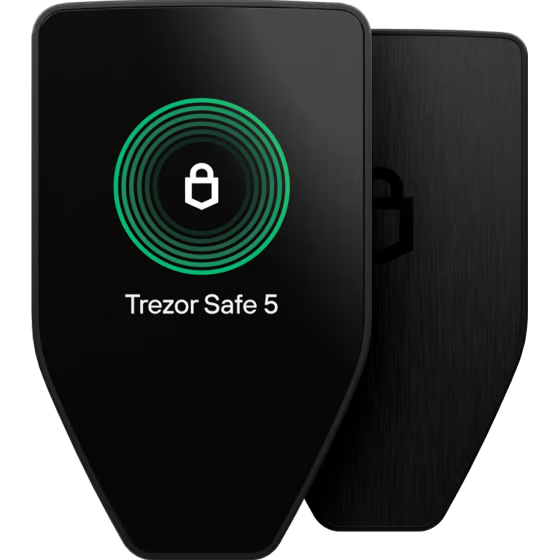
Unrelated, but if you don’t have a hardware wallet for your Bitcoin, for self-custody week Trezor is selling the Trezor Safe 5 for $103, and the Trezor Safe 3 for $47, with my recommendation being the Safe 5, though the Safe 3 is a great budget option. The touch screen of the Safe 5 is worth the extra expense.
https://blog.coinkite.com/one-coldcard-many-wallets-bip85/
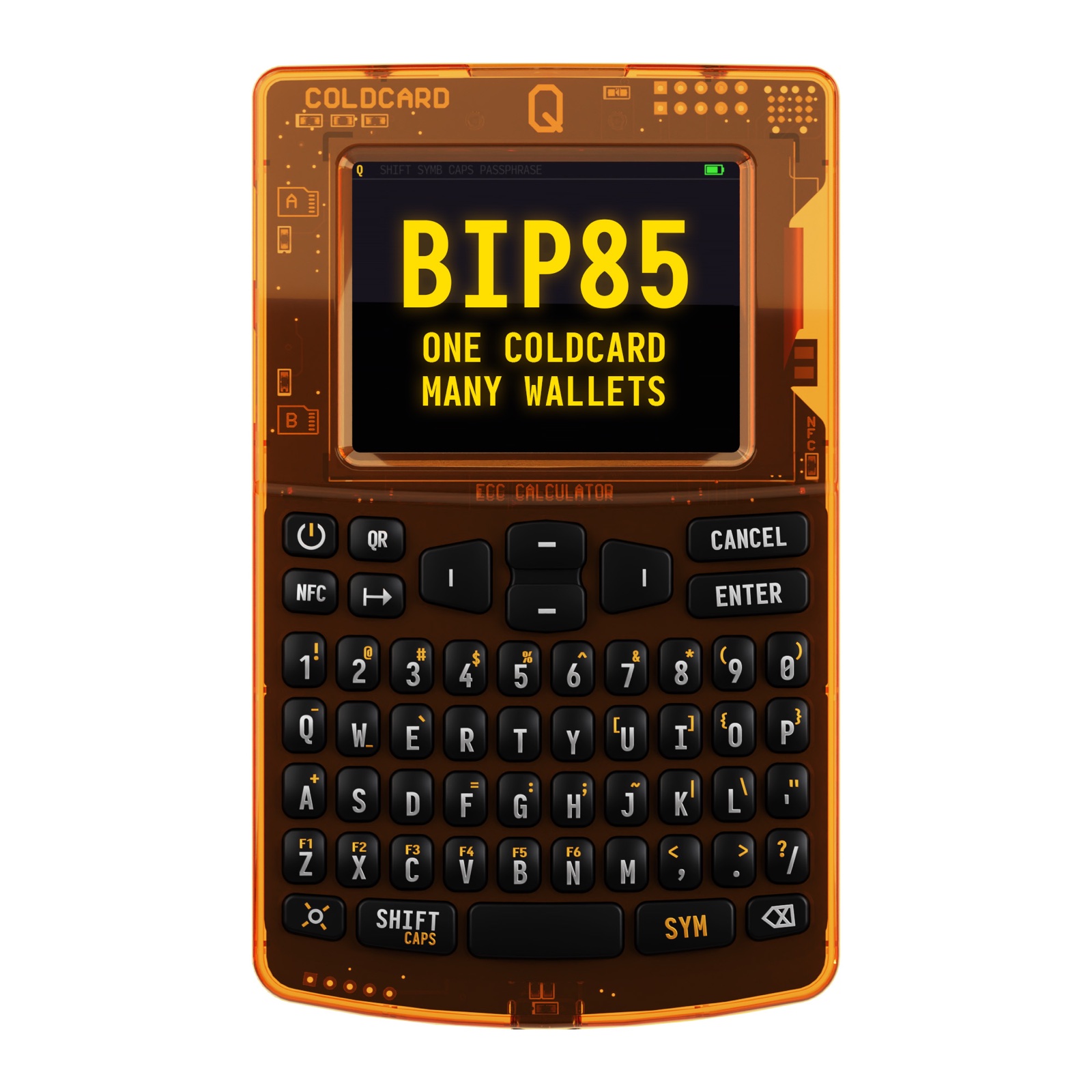
Every new wallet creates another seed phrase to record, hide, duplicate, and eventually recover. BIP-85 gives COLDCARD users another option: derive a different seed for each compatible wallet from one protected parent, without entering the parent seed into any of them.
Restore the same parent on a COLDCARD, select the same output type and index, and you get the same child again. A compromised child does not reveal its parent or siblings through BIP-85. A compromised parent can recreate every child.
That asymmetry is what makes BIP-85 useful—and what makes the parent backup so important.
Separate wallets without seed reuse
BIP-85 derives deterministic entropy from the active seed on your COLDCARD. COLDCARD can format that entropy as:
- 12, 18, or 24 BIP-39 words;
- a WIF private key;
- a BIP-32 XPRV;
- 32 or 64 bytes of hexadecimal data;
- a deterministic password.
For another hardware or software wallet, the usual output is a new BIP-39 seed phrase. Each application type and index produces a different result.
This is not seed reuse. Wallet A receives child 0. Wallet B receives child 1. Each gets different seed words, keys, addresses, balances, and transaction history. Neither destination receives the COLDCARD parent seed.
The parent remains the common recovery root. Its seed words or encrypted backup can recreate the children, provided you also preserved the information that selected each one.
What this fixes
Backup quality tends to fall as wallet count rises.
The main savings wallet may have a tested steel backup in two locations. A later mobile wallet gets words on a card. A test wallet lands in a notebook. Six months later, nobody remembers which phrase belongs to which application.
BIP-85 replaces some of those unrelated secret backups with one carefully protected root plus a recovery map. That map should record:
- the parent wallet or passphrase context;
- the BIP-85 output type and word count;
- the index;
- the destination wallet and network;
- any account, derivation, descriptor, or application data needed by that wallet.
The index is not a password. It tells COLDCARD which deterministic child to reproduce. Losing it does not expose the child, but it can turn recovery into a search.
This model is useful for a mobile spending wallet, another hardware wallet with a different interface, or a temporary wallet used for a specific job. The child can do that job without becoming another independent seed-generation and backup project.
Create a BIP-85 child on COLDCARD
Before starting, decide which COLDCARD seed will be the parent. If a BIP-39 passphrase or Temporary Seed is active, it becomes part of the parent context. You will need that exact context to reproduce the child.
For a simpler recovery plan, derive the child from the normal parent before entering a passphrase or loading a Temporary Seed.
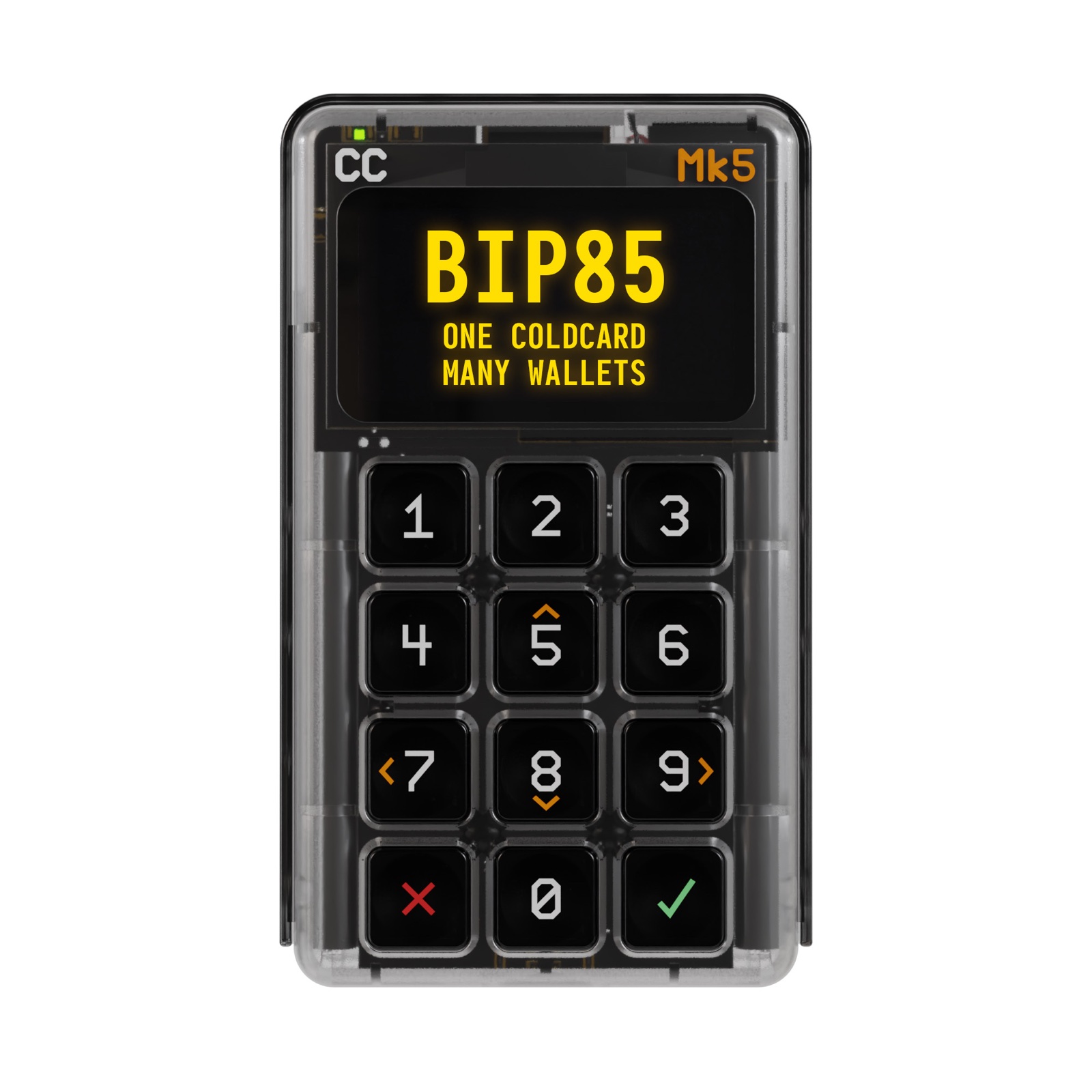
- On COLDCARD Mk4 or Mk5, open
Advanced/Tools > Derive Seed B85. - On COLDCARD Q, open
Advanced/Tools > Derive Seeds (BIP-85). - Read the warning, then choose the output format accepted by the destination wallet.
- Enter a unique index from
0to9999. - Record the output type, word count, index, and intended wallet in your recovery map.
- Display or export the child, then import it with the destination wallet’s official recovery workflow.
COLDCARD can move the result by MicroSD, Virtual Disk, NFC, QR, or USB keyboard emulation. Every export contains a live secret. Choose the narrowest path supported by the destination.
For another hardware wallet, prefer entering the words on that device when it supports on-device entry. Do not type seed words into a website. Do not leave an exported copy on an ordinary computer or MicroSD card unless that copy is part of a deliberate backup plan.
See BIP-85 in practice
These Coinkite walkthroughs show how to derive a dedicated child seed from COLDCARD and restore it on a mobile wallet or a Ledger. Only the child seed moves to the destination; the COLDCARD parent remains separate.
Mobile wallet
Ledger
Test the recovery path, not just the seed
A seed phrase can be correct while the recovery plan is incomplete.
Use a disposable wallet or resettable spare for the first test. Do not erase an existing funded wallet unless its independent backup has already been tested.
- Import the BIP-85 child into the destination wallet.
- Record its first receive address.
- Remove the child from the test destination.
- Recreate it on COLDCARD from the recorded parent context, format, and index.
- Restore it again and confirm the same receive address appears.
- Send and spend a small amount before using the wallet for meaningful funds.
The test checks more than the words. It checks whether your recovery notes identify the correct parent, passphrase state, output type, index, destination, and wallet settings.
Some wallets need metadata that a seed phrase does not restore. Multisig wallets need the complete wallet policy or descriptor. Account-based applications may need the correct account or derivation information. Follow the destination wallet’s documentation and preserve anything it says is required.
What BIP-85 does not protect
The destination wallet does not inherit COLDCARD’s secure elements, firmware, trusted display, or signing controls.
If you load a child into a phone, it becomes a hot-wallet secret. Malware, screen recording, cloud backup, or somebody with access to the unlocked phone may expose it. BIP-85 limits that failure to the child; it does not make the phone cold.
The reverse risk sits at the parent. Anyone who obtains the parent seed, any required passphrase, and the recovery map can recreate all of its children. Protect the parent for the total value and importance below it, not only for the balance visible on the parent wallet.
This shared root also means BIP-85 children are not independent multisig cosigners. Do not derive two or three members of the same multisig quorum from one parent. A single parent compromise would recreate the quorum and defeat the reason for multisig.
Privacy remains separate as well. The children are not cryptographically linked on-chain merely because they share a BIP-85 parent, but address reuse, transaction behavior, exchange records, and destination-wallet telemetry can still connect them.
Do not build one failure domain for everything
One parent can produce many children. That does not mean one parent should produce every secret you own.
Keep long-term savings separate from routine spending when the consequence of a shared-root compromise would be too large. A dedicated COLDCARD seed can serve as the BIP-85 root for spending wallets and experiments while a separate savings seed remains outside that tree.
The same rule applies to deterministic passwords, XPRVs, and WIF keys. Convenience is not a reason to put unrelated, high-consequence secrets under one root.
Choose the boundary first. Then use BIP-85 to make backups inside that boundary more orderly.
One root, a written map, and tested children
BIP-85 is a practical answer to wallet sprawl:
- keep the parent seed on COLDCARD;
- give each compatible wallet a different child;
- record the parent context, format, index, and destination;
- treat every exported child as a live secret;
- test recovery before funding;
- keep multisig cosigners and unrelated high-value secrets independent.
Read the full COLDCARD BIP-85 guide for every output and export option. The BIP-85 specification defines the derivation and test vectors.