

Anything with the UAE is of interest, as the country of the coming Antichrist, and seven heads of the Beast in Revelation, and also home to the Abrahamic Family House. So will this allow Little Sparta to ramp up their income to build up their military for the tribulation?
https://oilprice.com/Energy/Crude-Oil/UAE-Oil-Output-Climbs-After-Leaving-OPEC.html
By ZeroHedge
- UAE crude output climbed above 3.8 million bpd in June, its highest level since April 2020, months after quitting OPEC+.
- ADNOC is selling crude at discounted prices, and Chinese teapot refineries and California buyers are now showing up in its tenders for the first time.
- Gulf-wide exports rebounded sharply from Iran war lows, but Iraq’s shipments remain roughly one-fifth of pre-conflict levels.

The United Arab Emirates raised its crude output to near record highs above 3.8 million barrels per day in June, after the Gulf nation quit OPEC to escape production caps, Reuters reported citing two sources familiar with production data said on Monday. Bloomberg data showed even higher UAE exports, rising to 3.94mmb/d, just shy of the record hit in late 2025.
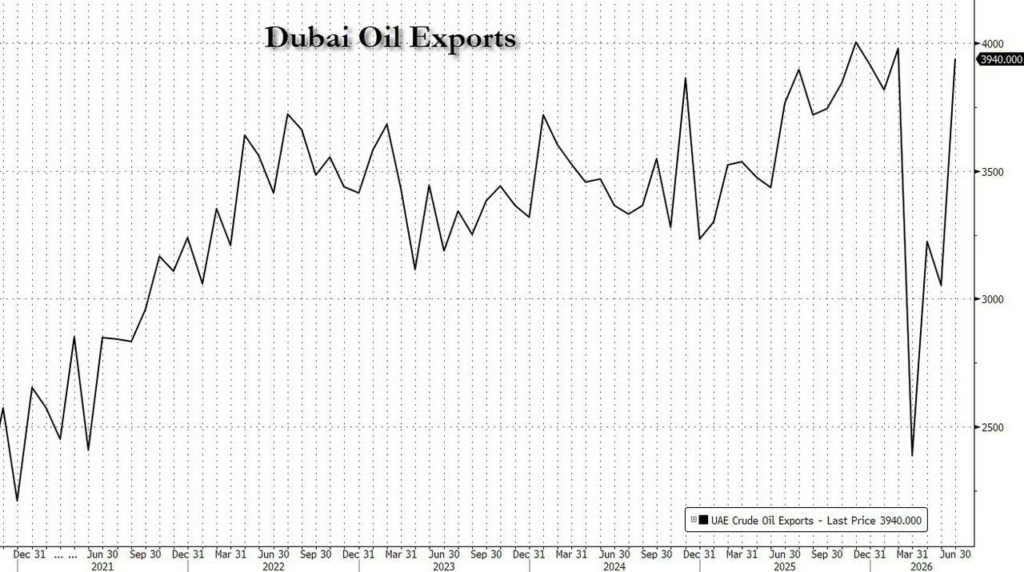
June’s output was the highest since April 2020, according to Reuters estimates, exceeding levels seen before the Iran war and providing an early vindication of the UAE’s decision to leave OPEC and OPEC+ on May 1 to free production from quota restrictions.
The UAE told OPEC it pumped 2.11 million bpd of crude in May at the height of the conflict shut-ins, down from about 3.40 million bpd in February. The International Energy Agency, however, assessed a much higher production level for both months, seeing May output at 2.8 million bpd and February at 3.64 million.
Underscoring the supply surge, Abu Dhabi National Oil Company (ADNOC) has been selling crude through tenders at discounted prices, traders told Reuters. The rebound has outpaced that of other Gulf producers, many of whom have restored exports through the Strait of Hormuz but remain well below pre-conflict production levels.
Abu Dhabi has argued that years of investment in production capacity justified greater freedom to produce oil, with Energy Minister Suhail al-Mazrouei saying at the time of the OPEC exit that the UAE owed it to investors to supply what global markets required “without restrictions”.
The jump in output comes as oil markets have shifted from concerns over severe supply disruptions during the Iran war, to worries about surplus supply. Brent crude, which hit a four-year high above $126 in late April, was trading at about $72 a barrel on Monday, around levels seen before the outbreak of the Iran war in late February.
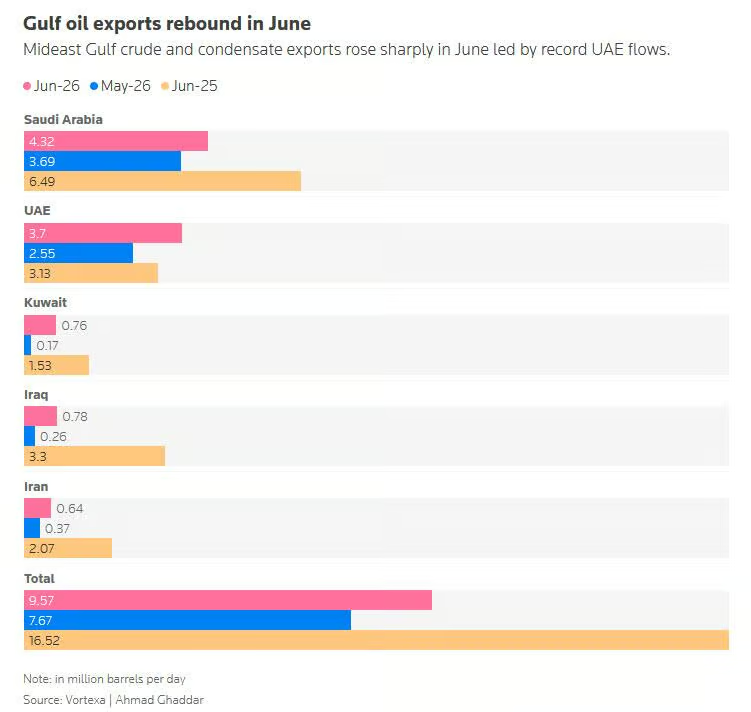
Other Gulf nations also saw a surge in output: combined crude and condensate exports from Saudi Arabia, the UAE, Kuwait, Iraq and Iran rose by more than 3.5 million bpd from May to 10.07 million bpd, Kpler data shows. Vortexa, another cargo analytics company, estimated June flows at 10.2 million bpd, up from 7 million bpd in May but still way short of the 16.5 million bpd a year earlier.
Saudi crude exports averaged 4.32 million bpd in June, according to Vortexa data, around 3 million bpd below February levels. Kuwaiti output rose to 1.65 million bpd in June, roughly triple May levels but still nearly 1 million bpd short of pre-conflict production. Iraq, OPEC’s second-largest producer, exported about 780,000 bpd in June, roughly one-fifth of volumes shipped before the conflict, Vortexa data showed.
Since the June 17 agreement between the U.S. and Iran to halt the conflict and restore shipping through the Strait of Hormuz, the backlog of crude stranded in the Gulf cleared more quickly, leaving about 23 million barrels still to transit the waterway, said Kpler analyst Johannes Rauball.
Meanwhile, in a curious twist, Sparta senior oil market analyst June Goh said that Chinese teapot refineries have emerged as buyers in Adnoc’s latest oil tender, drawn by wider discounts amid a short-term glut. Adnoc sold about 18 million barrels of crude via in fifth tender for loading through August; Upper Zakum was the main grade sold, while some Das also changed hands.
The observation in this tender is that the Chinese teapots are now out buying, whereas in previous tenders they were not even in the buyer list, indicating that the current discounts are now at a level that competes with Iranian and Russian alternatives.
According to Sparta, the current ‘mini-glut’ reflects mismatch of prompt availability vs usual trading window two months ahead, where Mideast barrels should now be trading for September loading instead. However, unless Asian buyers pile up to refill empty SPRs, these extra barrels will need to first fill up commercial storage and then relieve the pressure in arbitrage trades to the West.
It wasn’t just China: California is also buying UAE oil – some cargoes of Adnoc grades moved to US buyers via private negotiations, with likely destinations to US West Coast refineries.
Brent-Dubai EFS doesn’t necessarily need to widen that much more because diving crude differentials are doing most of the heavy lifting to keep the arbs open into northwest Europe.