

Things are ramping up fast for the mark of the beast system, which seems to indicate that God is limiting the church age to 2,000 years, like He’s limiting His earthly personally run kingdom to 1,000 years. If we put the start of the 2,000 years at the start of his ministry on earth, it makes all the 2030 agendas make a lot more sense. Not only are they working on age verification leading to digital ID based on biometrics, but they’re co-opting opensource, free software to make it compliant as well. And the real end goal is an agentic AI on your computers to monitor you like the television in 1984, but with this the AI agent will be watching you 24/7, flagging and reporting any objectionable behavior directly to the government, commencing a wave of persecution the world has never seen. I wouldn’t miss the extraction before God’s judgement is unleashed on the world.
https://reclaimthenet.org/eu-mandates-driver-facing-cameras-in-new-cars-from-today
Surveillance just became a factory-fitted option you can’t decline.
By Ken Macon
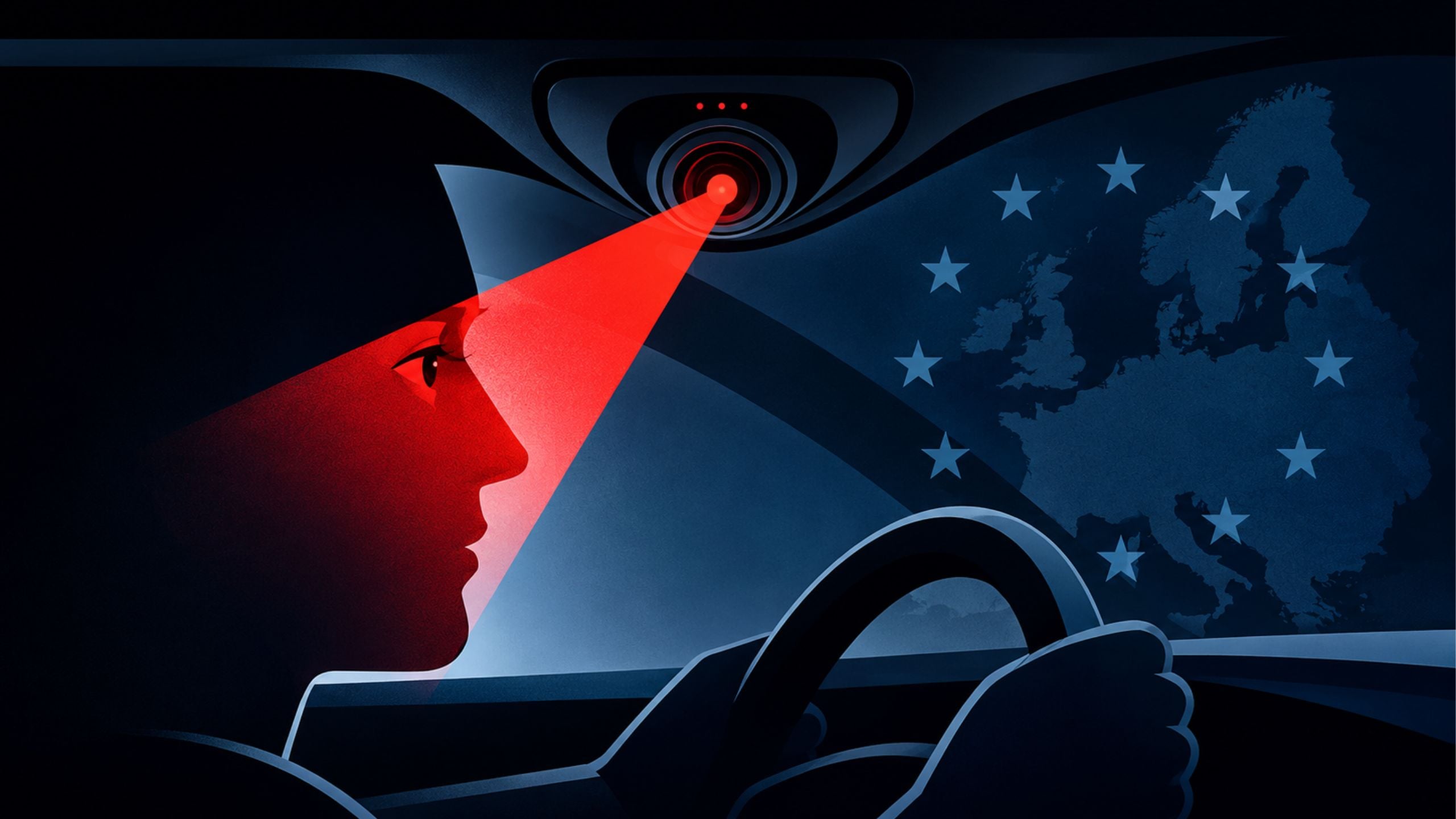
Every new car and van sold across the European Union will watch its driver from July 7, when an infrared camera aimed at the person behind the wheel becomes a legal condition of sale. The requirement reaches tens of millions of vehicles a year, and it arrives wrapped in the language of safety.
The rule goes by Advanced Driver Distraction Warning, or ADDW, and is inside the bloc’s General Safety Regulation, formally 2019/2144. Carmakers have had to fit it to new vehicle types since July 2024. From July 7, 2026, they must fit it to every new car and van that reaches the market.
The camera tracks where a driver’s eyes are aimed and how the head is positioned, then judges whether the driver has looked away from the road for too long. Glance off for more than six seconds at speeds between 20 and 50 km/h and the system has to warn you. Above 50 km/h the allowance shrinks to three and a half seconds. Each warning has to be visible, reinforced by sound or a physical buzz, and it grows more insistent the longer the software believes your attention has drifted.
Brussels sells this as lives saved. The Commission expects the wider safety package to prevent more than 25,000 deaths and 140,000 serious injuries by 2038, part of a long-running target called Vision Zero that aims to end road fatalities by 2050. “The EU is a world leader in general safety rules for vehicles,” said Thierry Breton, then the bloc’s internal market commissioner, as the broader rules took effect. “We ensure that innovative technology solutions can be used to improve safety on our roads.”
Set the messaging aside and a plainer fact remains. A law now requires a camera to face you for the entire time you drive. It is not an option you enable or a feature you pay to add, but a standard condition of owning a new vehicle.
The regulation does carry a limit. The system cannot use facial recognition or any biometric identification of the people inside the car. The data it generates is not allowed to leave the vehicle, and it cannot be passed to third parties. The camera may know where your eyes are aimed while being forbidden from knowing who you are.
Those are somewhat favorable rules, but they are also just settings. Data can get stolen or accidentally swept up. A later revision could loosen any of them. Regulators who mandate the hardware today can widen its job tomorrow and, by then, the expensive, fiddly work of wiring a camera into every cabin will already be finished. Once the lens is in and the software is running, the open question stops being whether cars can watch their occupants and turns into what else that watching should cover.
None of this depends on pretending that texting at 120 km/h is safe. The worry is normalization. A generation of drivers is about to grow up treating a machine that studies their face as an ordinary part of travel, the way we came to shrug at always-on phones and doorbell cameras that report home. Consent gets manufactured through sheer repetition.
Someone also has to pay for the hardware and that someone is the buyer. Cameras, processors, and the code that runs them cost money, and the bill lands on the sticker price of cars that already cost plenty. Switzerland and other markets that track EU rules will follow, stretching the reach of the mandate well past the bloc’s own borders.
There is a strange asymmetry in how Europe treats machines that watch drivers against machines that drive. Advanced self-driving features that their makers say cut crashes face tight restrictions on European roads, while a camera trained on your eyes becomes compulsory.
As dealerships across the continent open their doors this month, buyers are agreeing to more than a set of keys. They are accepting a camera on every trip, on the promise that the footage stays in the cabin and the software only ever cares about their eyes. That promise holds right until the day someone decides it no longer should.