

This is a good write up on the stupid practice of using ethanol in fuel. I wish I had a local Buc-ee’s, as when we go there in Colorado for a brisket sandwich, I fill the tank up with ethanol free fuel, and I notice a difference in how the Subaru runs as well as how the tank lasts over the E10 Sam’s Club fuel. Anyway, this covers while you should just avoid the E15 fuel, even if you have a newer vehicle.
https://www.ericpetersautos.com/2026/05/31/the-gasohol-pushers/
By eric
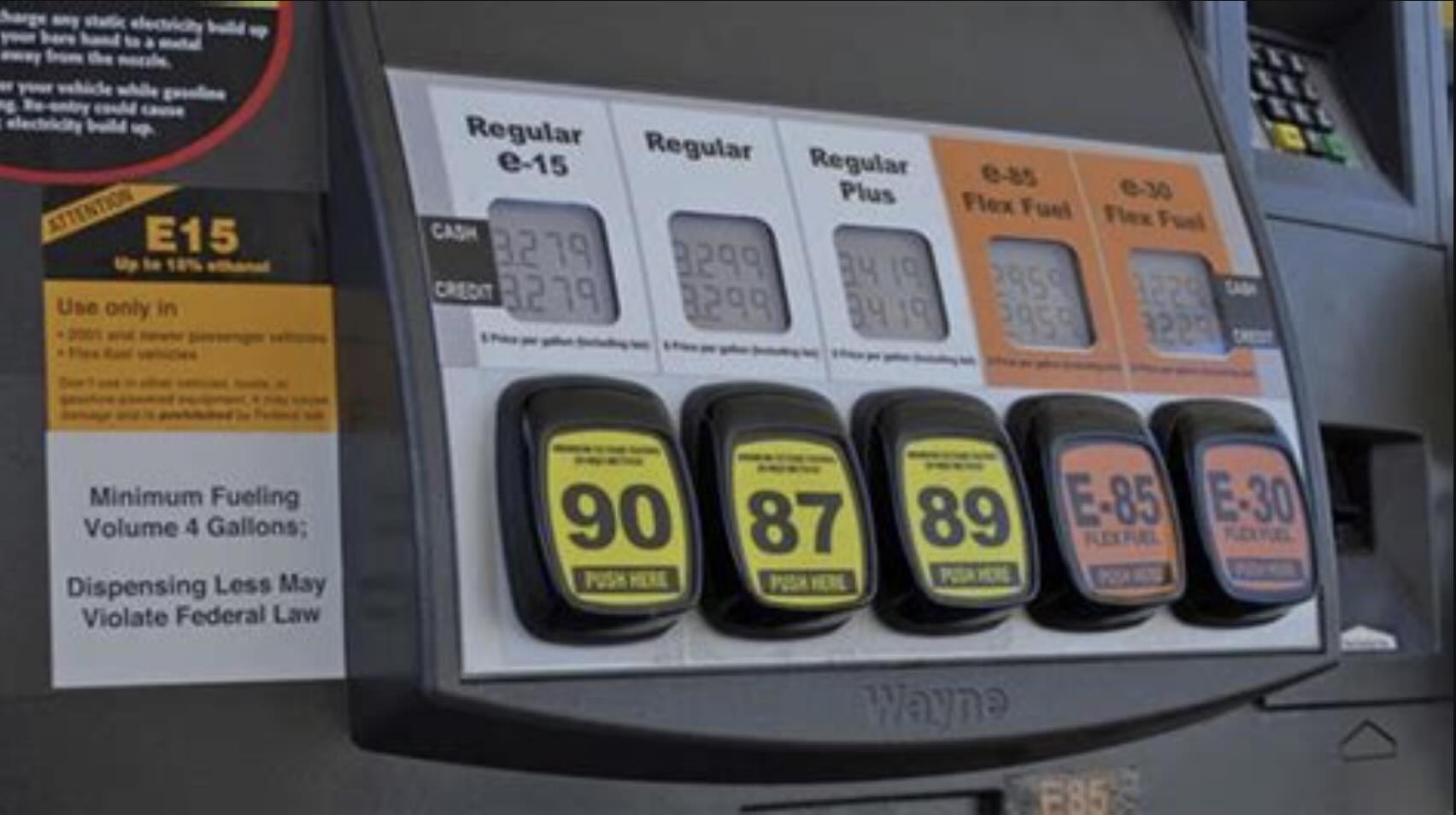
There’s a term you don’t often hear anymore – probably because there’s too much truth in it: Gasohol. It is “gas” that’s adulterated with alcohol. We put this adulterated fuel in our tanks as a matter of course, since almost all the “gas” that is commonly available is at least 10 percent alcohol. It is sold as “E10,” which translates as “gas” that’s 10 percent ethanol (ethanol is alcohol).
E15 is 15 percent alcohol. It is becoming commonly available and people are being wheedled into buying it because it costs less than E10 (and a great deal less than actual gasoline, if you can still find it) and $4.10 per gallon sounds great to people who are having to pay $4.50 for E10.
The catch is it’s another grift, the defining characteristic of Stage 5 America.
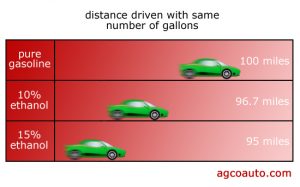
It costs more to burn ethanol – because alcohol isn’t as energy-dense as gasoline. Put another way, you have to burn more alcohol-laced gas to get a car to travel a given distance; this is true of E10 as well as E15, only more so in the case of E15. People don’t generally notice, though – because they don’t have an easy way of making a direct comparison. The adulteration of the fuel supply began decades ago, back in the 1980s. The idea at first was that this would serve as a kind of pour-in emissions control because alcohol-laced gas leaned out the fuel mixture; the problem was this made carbureted engines run hotter and it did nothing to reduce the emissions of fuel-injected engines because their computer controls simply richened up the fuel mixture to compensate for the alcohol.
But it was a boon-grift for Big Agra – aka the corn lobby – which has been making fat stacks peeing in our gas tanks (so to speak) ever since.
It is arguably one of the greatest con jobs ever. For more than 40 years, people have been effectively forced to buy adulterated fuel and getting reduced gas mileage as a result. The cost isn’t trivial.
The fuel economy of an engine that burns E10 is reduced by about 3-4 percent. Using E15 increases that reduction to 6 percent, if not more. Given a vehicle that averages say 30 miles-per-gallon – burning gasoline – you’d lose about 1.2 MPG burning E10. The same vehicle would only go about 28.8 MPG. Given a typical 13 or so gallon gas tank, the loss would be about 16 miles of driving range. If you filled up this car four times a month, the loss would be about 64 miles of driving range per month. Factor that out over a year and the loss comes to about 768 miles of lost driving range, the equivalent (roughly) of two full tanks of gas, which – at today’s $4.50 or so per gallon – amounts to a cost to you of (roughly) $117. Factor that out over 20 years and it gets to be a pretty considerable cost doesn’t it? About $2,400, to be precise about it.
That sum would pay many people’s gasoline bills for close a year.
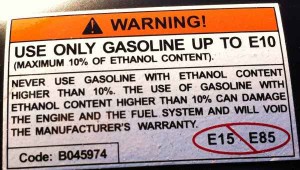
E15 increases that cost – and not just in terms of your car going less far than it used to. “Gasoline” with that much alcohol in it – 15 percent, remember – is too much alcohol to be safely burned in engines not specifically made to burn it because it’s more than just a matter of adjusting the air-fuel ratio to compensate for the high-alcohol-content “gas.” Most vehicles made before the early-mid 2000s were not made to safely use E15 and in many cases, the vehicle’s manufacturer warns not to use E15 “gas” due to potentially catastrophic materials failure caused by the alcohol, which breaks down rubber seals, plastics, gaskets and so on. Regardless of the vehicle’s vintage, if it has steel gas lines and a steel gas tank, the alcohol will tend to egg-on rust inside the lines and the tank, because ethanol absorbs moisture (water) from the the air and water plus steel equals rust. The flakes will then slough off and get sucked down the line into your fuel injectors and engine.
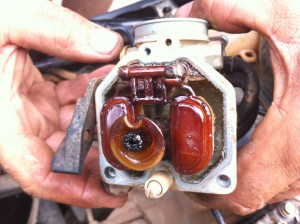
Carbureted engines (which almost all modern outdoor power equipment engines still have and almost all cars made before about 1982 also have) are more vulnerable because the fuel system is open to the air and because carbs (in automotive applications) generally predate alcohol-laced gas and were never designed for it. To avoid problems, it is necessary take the carburetor apart and replace all the soft parts – gaskets, seals and so on – with ethanol-compatible parts and also to re-jet the carburetor to compensate for the “leaner” fuel. Steel gas tanks and lines should also be replaced with stainless steel parts. This gets into money. It also assumes the replacement parts are available. In many cases, they are not.

It is likely that E15 – if it becomes the new E10 (replacing E10 as the mass market fuel) – will accelerate the demise of all vehicles made before about ten years ago and especially vehicles made before about 25 years ago, when few were designed to be able to handle E15 fuel. While this might not be deliberate, it will nonetheless the end result of this pushing of alcohol in ever-higher-concentrations into the fuel supply. Given that there is no longer an “emissions” justification and hasn’t been, for more than 40 years (since the widespread adoption of self-adjusting electronic fuel injection) one wonders why they keep pushing alcohol into the fuel supply.

Especially in view of the fact that we have plenty of gasoline – because there is more than enough oil right here in the United States to provide for all of our domestic consumption needs. But we don’t actually – because much of this oil is exported – which is why Americans are paying $4.50 per gallon for gas adulterated with 10 percent alcohol and are being peddled “gas” adulterated with 15 percent alcohol. It is a cheap way to replace the gas that’s been taken out of the fuel supply and fool the rubes into thinking they’re getting less expensive “gas.”
Ah yes, my little chickadees!