

And the question remains, who helped Iran with their guidance systems? Is it Russia who is sharing intel, or China selling them anti-ship missiles in a recent deal. Russia has offered to stop sharing intel with Iran if the US stops sharing intel with Ukraine. And it makes you wonder who is behind some of the drone attacks on Russian tankers along with the EU countries capturing them too. As I’ve seen reported, the Russian natural gas tanker hit in the Mediterranean was never claimed by Ukraine, and one report floated that the drone came from Libya now working on salvage efforts. US megacorp interests stand to make a lot of money moving natural gas now that a lot of supply has been taken offline and ships can’t move through the Straight of Hormuz. And see these two quotes from a second article I posted at the bottom which was written before the war.
Oil majors have all signaled they have special plans for gas. Shell, for instance, said earlier this year it would make LNG a priority for the next 10 years. CEO Wale Sawan said LNG would be the company’s “biggest contribution to the energy industry” in the period. BP is making plans for both oil and gas production growth, revising its peak oil demand projection by five years.
In October, the US became the first country to export 10 million tons of liquefied gas in a single month, enjoying solid demand from Europe, which earlier this year signed a commitment to buy significant volumes of both LNG and oil to get President Trump to lower tariffs.
https://southfront.press/iranian-strikes-hit-patriot-system-long-range-radar-in-bahrain-photos/

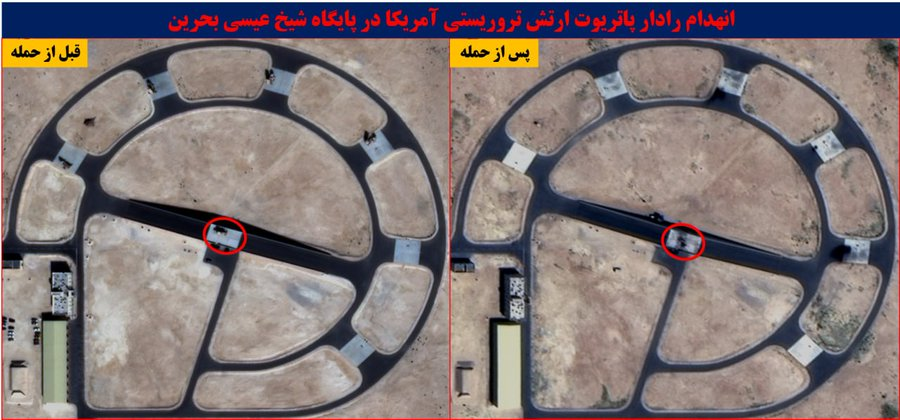
Iranian strikes hit an American-made MIM-104 Patriot air defense system in southern Bahrain, and inflicted some serious damage on a key air base located nearby, according to satellite images shared by Iranian media on March 23.
The Islamic Republic has been targeting Israel in addition to facilities hosting or supporting the U.S. military in neighboring countries since the start of the American-Israeli war against it.
The system, deployed at an independent site to the southwest of Shaikh Isa Air Base, took a direct hit, right in the area where its AN/MPQ-65 fire control radar is situated. Burn marks were also visible in the areas where M901-series launching stations are typically deployed.
The Patriot is a long-range air defense system, primarily used by the U.S. military and its allies to intercept ballistic missiles at their terminal phase. A single system with its missiles could cost as much as $1 billion. The radar on its own is reported to be worth more than $110 million.
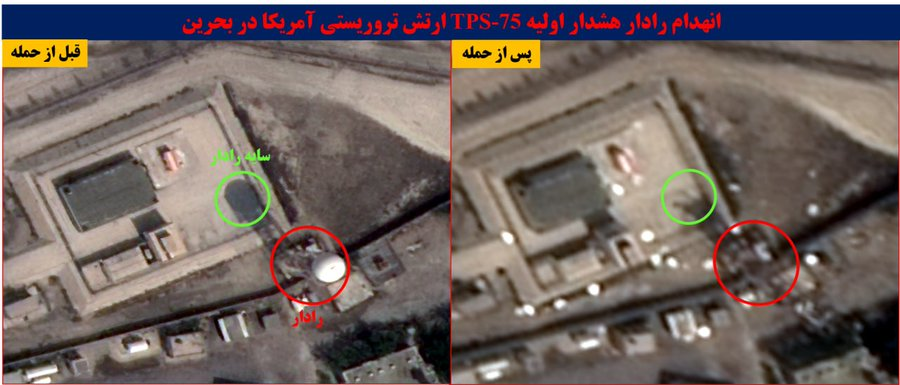
At Shaikh Isa, damage was also noted. An American-made AN/TPS-75 transportable passive electronically scanned array air search 3D radar deployed on a tower under a radome was completely destroyed. A single radar of type could cost as much as $8 million.
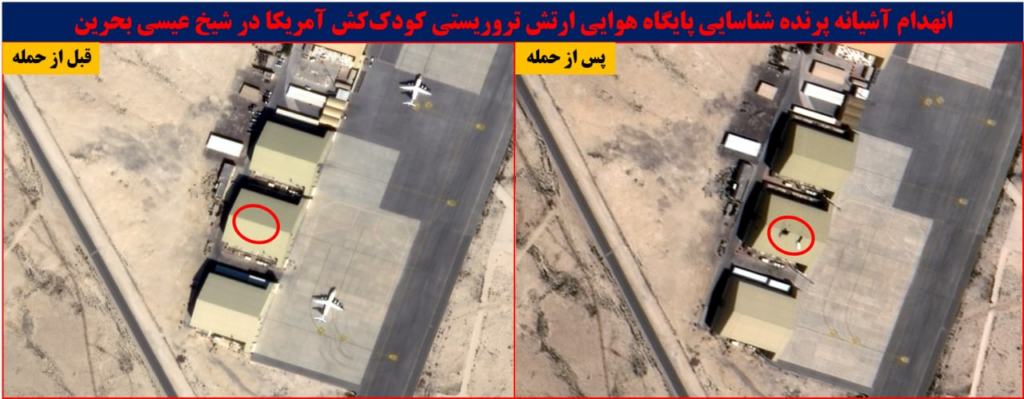
The satellite images also revealed that one of the air base’s large hangars, where large military transport aircraft are typically kept, also received a direct hit.
Shaikh Isa services at a critical logistic hub for the U.S. Central Command (CENTCOM), and the air base’s operations support services are even run by an American company, KBR, Inc.
Taking into account the U.S. large military presence in Bahrain it is hard to guess if the Patriot hit was American, or belonged to the Gulf country.
In fact, a recent report by Reuters revealed that an interceptor fired from an American-operated Patriot injured dozens of people in Bahrain on March 9.
Both Bahrain and Washington blamed an Iranian drone attack for the blast, which the Gulf country said injured 32 people including children, some seriously. Commenting on the day of the attack, CENTCOM said on X that an Iranian drone struck a residential neighborhood in Bahrain.
Iran has managed to hit many air defense systems and radars, mainly belonging to the U.S. military, across the region since the start of the war, causing billions of dollars worth of damage. The Patriot hit in Bahrain was not the first. There are reports that similar systems were targeted in Iraq, Kuwait, and the United Arab Emirates.
US Natural Gas Output and Demand to Smash Records in 2025

The production of US natural gas and demand for it will both end the year at record highs, according to the US Energy Information Administration’s Short-Term Energy Outlook cited by Reuters on Dec. 9.
For dry gas production and LNG exports, the totals will keep rising in 2026.
EIA projected dry gas production will rise from 103.2 billion cubic feet per day in 2024 to 107.7 bcfd in 2025 and 109.1 bcfd in 2026. That compares with a record 103.6 bcfd in 2023.
The agency also projected domestic gas consumption will rise from a record 90.4 bcfd in 2024 to 91.8 bcfd in 2025 before sliding to 90.8 bcfd in 2026…
The agency forecast average U.S. liquefied natural gas (LNG) exports would rise to 14.9 bcfd in 2025 and 16.3 bcfd in 2026, up from a record 11.9 bcfd in 2024.
At the beginning of November, US natural gas futures climbed to their highest level since March, driven by anticipated colder weather increasing domestic heating demand and record-breaking LNG exports to European and Asian buyers.
Robust international demand for US LNG reinforces its strategic role as a crucial transition fuel and a geopolitical tool, potentially driving significant investment in expanding export infrastructure, including the long-stalled Alaska LNG project.
Part of the comeback story for natural gas has to do with the Trump administration’s support of fossil fuels and pivot away from Biden’s focus on clean energy.
In the final year of his term, President Biden imposed a moratorium on new LNG export capacity, based on a study by a researcher who claimed that LNG production resulted in more emissions than burning coal. This was perhaps meant to drive investors away from the commodity, like so many studies before it. But it didn’t. Global demand for natural gas has been growing quite healthily, despite the surge in alternative energy sources.
Oil majors have all signaled they have special plans for gas. Shell, for instance, said earlier this year it would make LNG a priority for the next 10 years. CEO Wale Sawan said LNG would be the company’s “biggest contribution to the energy industry” in the period. BP is making plans for both oil and gas production growth, revising its peak oil demand projection by five years.
Australia’s Woodside Energy recently said it expected its sales of crude oil and natural gas to rise by some 50% by 2032, driven by growing demand for energy, which the company sees at 6% annually over the next five years.
The expected surge in liquefied natural gas export capacity in the United States is on course to boost gas consumption significantly, from around 18 billion cu ft right now to as much as 40 billion cu ft—and that 18 billion cu ft is already an all-time high.
The United States turned into the world’s largest exporter of LNG in a matter of years as energy companies raced to build new liquefaction trains along the Gulf Coast in response to the surge in demand for a lower-emission alternative to coal.
In October, the US became the first country to export 10 million tons of liquefied gas in a single month, enjoying solid demand from Europe, which earlier this year signed a commitment to buy significant volumes of both LNG and oil to get President Trump to lower tariffs.
The EU has been breaking records in LNG imports since 2022, even as it tries to move away from the commodity. Germany this year saw the highest volumes of gas-fired generation since 2019.
The country to date has five LNG import terminals featuring floating storage and regasification units. The import terminals provide Germany with an import capacity of 70.7 million tons of liquefied gas annually by 2030. Germany is set to become the world’s fourth-largest LNG importer, after South Korea, China, and Japan.
Meanwhile, US natural gas pipeline capacity is set for its biggest one-year expansion since 2008. Surging demand from LNG exporters, data centers and manufacturing is driving a $50 billion investment boom.
The Permian Basin remains the focal point, with new projects like ExxonMobil’s stake in Enterprise’s Bahia pipeline and TC Energy’s forecast of a 45 Bcf/d demand surge by 2035 highlighting the sector’s long-term growth outlook.
The US federal government is considering further steps to speed up the buildout of liquefied natural gas export infrastructure as flows of natural gas to LNG plants hit a record high. Exports are also running at all-time highs.
The Federal Energy Regulatory Commission’s chairwoman announced the coming changes in a statement that said, “Energy infrastructure needs to be built now, and existing projects need to be maintained efficiently to ensure grid reliability today and in the future. We are taking a hard look at our processes and ways we can simplify certain activities.”
If the FERC goes ahead with the planned changes, it could encourage even faster growth in LNG export capacity as global energy demand forecasts see consistent growth in demand for liquefied gas specifically.