

The war on opensource is on with users being the victims, though easily avoided with a VPN for now. And all this incremental age verification is just to push us towards a digital ID by making it more palatable. I still think they’ll need a major false flag cyber event or series to move the needle for most of the world’s population, and the WEF was fearmongering just such a scenario a few years ago.
https://linuxiac.com/linux-distributions-begin-blocking-brazil-access-over-new-digital-law/
Several Linux distributions are restricting access from Brazil due to concerns about a new digital law impacting online software distribution.
By Bobby Borisov

Some Linux distributions have started restricting access from Brazil in response to concerns about a newly enforced digital law that could affect online software distribution in the country.
Community discussions on Reddit indicate that projects such as Arch Linux 32 (an independent 32-bit Arch derivative) and the Fedora-based Bazzite have either blocked Brazilian IP addresses or are assessing the situation.
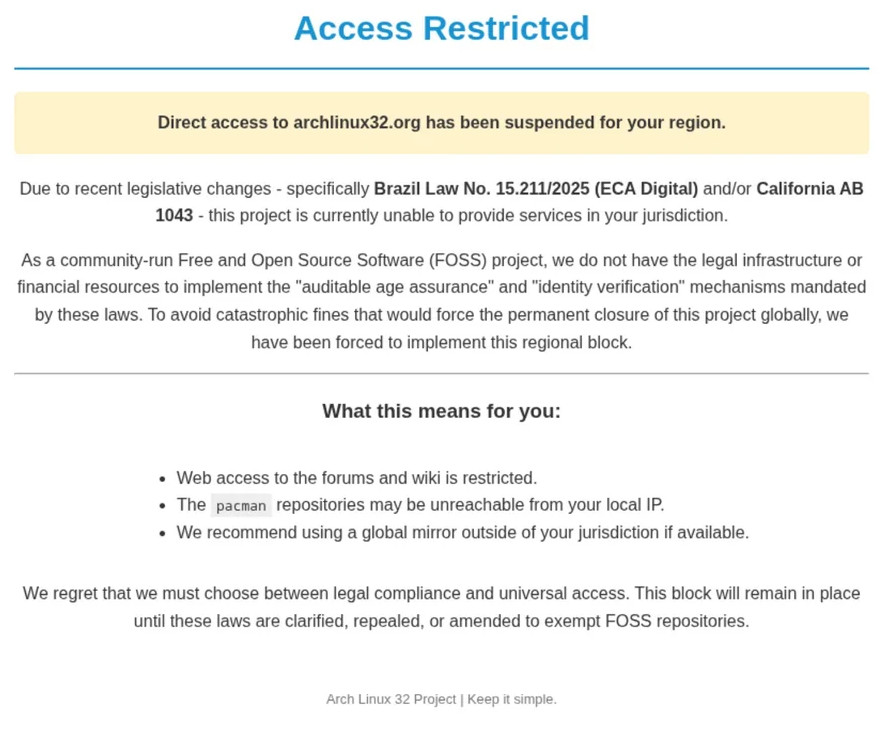
These actions appear to be precautionary and not coordinated, with each project independently assessing potential legal risks. In some cases, maintainers have not issued formal statements, so available information relies on user reports.
The issue is linked to Brazil’s Federal Law No. 15.211/2025 (original text in Portuguese), commonly known as the “ECA Digital.” The legislation, approved in September 2025, introduces new rules to strengthen protections for minors in online environments.
After a transition period of roughly six months, the law officially took effect on March 17, 2026, which aligns with the timing of the reported access restrictions.
The law imposes broad requirements on digital platforms and services accessible to minors, such as stronger safeguards and, in some cases, reliable age verification. However, its scope is not clearly defined and does not specifically mention open-source software or Linux distributions.
This ambiguity has led developers to worry that hosting downloadable Linux images could be considered a regulated digital service. In this case, projects might be required to implement compliance measures that are impractical for most open-source communities.
As a result, some maintainers have temporarily blocked access from Brazil or issued warnings while awaiting clearer legal guidance. Others are monitoring the situation without taking immediate action.
A recent notice on the Manjaro forum, posted before the law takes effect, points out the uncertainty that Linux distributions are facing. Developers say it may be hard to apply the new rules to open-source systems and are considering steps like installer warnings or limiting user profiles for minors. However, so far, there is no clear plan for compliance.
Further clarification from Brazilian authorities or regulators is expected to determine whether these restrictions will remain or be lifted.