

I have a theory that the Antichrist, or Muslim Messiah, the Mahdi, is the crown prince of Dubai, which is funny as the Iranians are attacking his emirate. As the western linked Arab nations are using up their missile interceptors, this is going to make the defense companies a lot of money restocking their supplies and possibly selling even more. And Iran is probably getting all they can handle from Israel and the US, but the UAE is referred to by American generals as Little Sparta, with all their officers trained by the US or the UK, with the best equipment money can buy. I’d bet they’re itching to join in on the sorties if not already. And Saudi Arabia is equally annoyed and was wanting to join in as well. Iran is just making sure all their leaders get wiped out with prejudice.
Written by Vertika Kanaujia
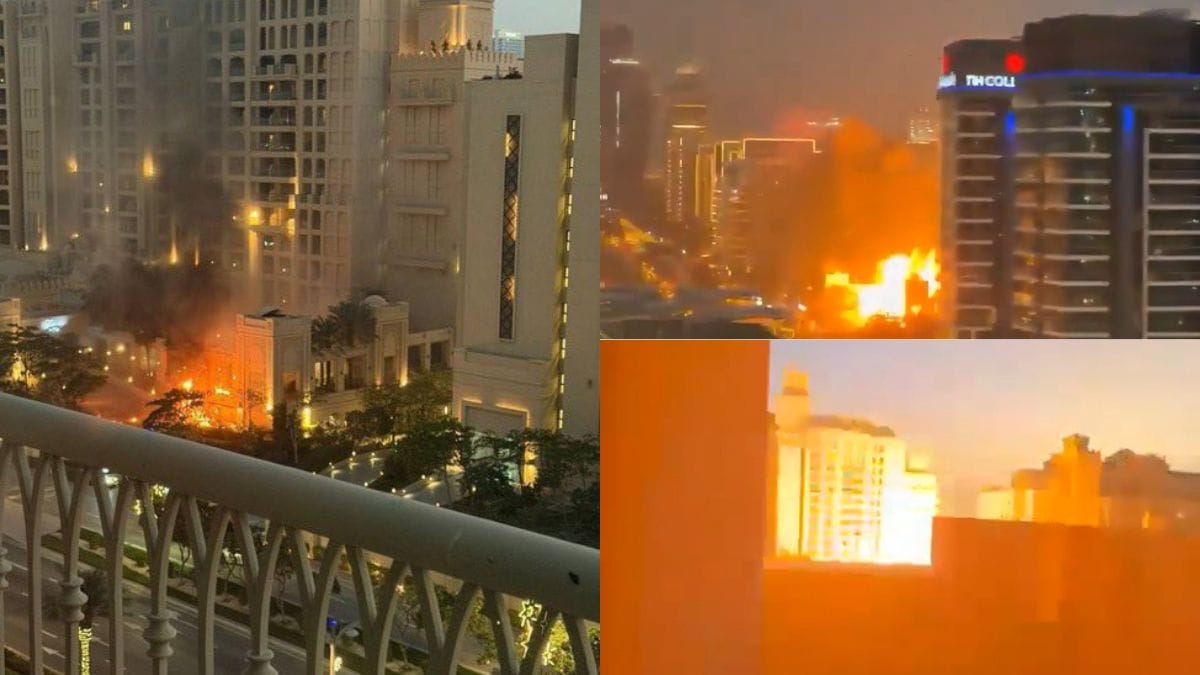
Dubai, a city that built itself into the connective tissue of global travel, went dark on Saturday.
At 8:35 am local time, Dubai Airports issued a four-line statement: flight operations at Dubai International and Dubai World Central–Al Maktoum International had been “suspended until further notice.”
By afternoon, a hotel on Palm Jumeirah was on fire. By evening, the city was shut, a concourse at Dubai International had been damaged by an Iranian drone, port was up in flames, the Burj Khalifa evacuated, and the city that had spent decades selling itself as the world’s most stable address was telling its residents to stay away from windows.
In less than twelve hours, Iran had done what no adversary had managed in Dubai’s entire modern history — it had made the city feel unsafe.
The attack continued until Sunday (March 1). The UAE Ministry of Defence recently confirmed that 165 Iranian ballistic missiles were detected, of which 152 were destroyed, while 13 fell into sea waters. Two cruise missiles were also detected and destroyed.132 were destroyed while five fell into the sea.
A total of 541 Iranian drones were detected, of which 506 were intercepted and destroyed, while 35 fell within the country, causing material damage.
The incidents resulted in the demise of three individuals who were of Pakistani, Nepali and Bangladeshi nationalities. Alongside these deaths, 58 minor injuries were reported among nationals of Pakistan, Iran, India, Bangladesh and Sri Lankan.
The Ministry of Defence has announced that the UAE air force and air defence forces have so far dealt with 165 ballistic missiles, two cruise missiles and 541 Iranian drones since the start of the Iranian attack.
The ministry said that on the morning of the second day of the… pic.twitter.com/rj8e5iXrQ5— وزارة الدفاع |MOD UAE (@modgovae) March 1, 2026
Dubai Attacked: All That Was Hit
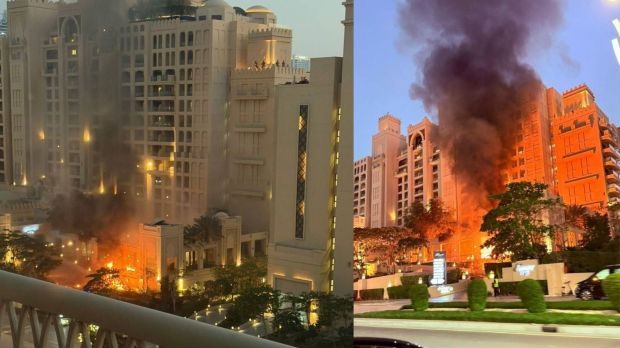
The most dramatic strike was on Palm Jumeirah — the archipelago of artificial islands that defines Dubai. Photos and videos showed flames spreading across a luxury hotel in the centre of Palm Jumeirah. The Dubai media office confirmed the strike resulted in a fire with four people injured.
The attacks came in waves. Loud booms were heard across Abu Dhabi and Dubai throughout Saturday, according to five witnesses including two Reuters correspondents.
A separate fire broke out at Jebel Ali port after debris from an interceptor triggered a blaze.
Debris from an intercepted drone sparked a fire at the base of the Burj Al Arab. Videos of Burj Khalifa being attacked have been confirmed as fake.
Dubai Airports confirmed that a concourse at Dubai International sustained minor damage in an incident, which was quickly contained. Emergency response teams have been immediately deployed as thousands wait for operations to begin.
In Abu Dhabi, a Pakistani resident died after shrapnel fell on a residential area.
The UAE Ministry of Defence has said that its air defences destroyed 132 missiles launched toward the country and intercepted 195 Iranian drones during the day’s attacks.
Dubai Airports Go dark
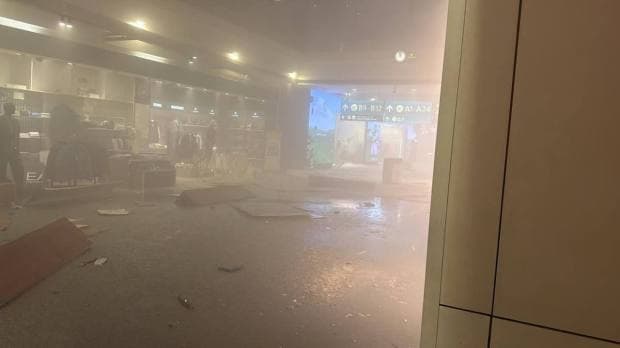
Flight operations at Dubai International, the world’s busiest airport by international passenger traffic, and Dubai World Central Al Maktoum International were suspended until further notice.
Emirates, the world’s largest international airline, suspended all flight operations to and from Dubai, citing “multiple regional airspace closures.”
The human scenes inside the terminals told the story more vividly than any data. Alarms blared across terminals at Abu Dhabi International Airport, sending panicked passengers towards the exits. National Guard personnel swiftly moved in, taking control of the airport premises and advising remaining passengers to stay inside the building for their safety.
Dubai International Airport pic.twitter.com/zQ3DLb2Lpr— jeet yadav (@jeetyadav1201) March 1, 2026
Several Indians have been stranded at the airport. PV Sindhu wrote his ordeal. “The situation is becoming more frightening by the hour. A few hours ago, there was an explosion close to where we were holed up at the airport. My coach had to quickly run out of the area as he was closest to the smoke and debris. It was an extremely tense and scary moment for all of us.”
Indian workers based in Dubai who were at the airport at the time were advised by officials to return to India as soon as conditions permitted. Airport administration arranged emergency food and water for stranded passengers. In the duty-free corridors that ordinarily hum with the sound of rolling luggage and luxury retail, families sat on floors eating airport sandwiches, watching the news on their phones, and waiting for information that never came.
The aviation losses are already compounding.
Aviation consultant Linus Bauer warned: “If disruptions remain short-lived the impact is manageable. If airspace avoidance persists, airlines face structurally higher operating costs, weaker aircraft utilisation and profit margin pressure — especially on long-haul networks reliant on Middle East transit corridors.”