

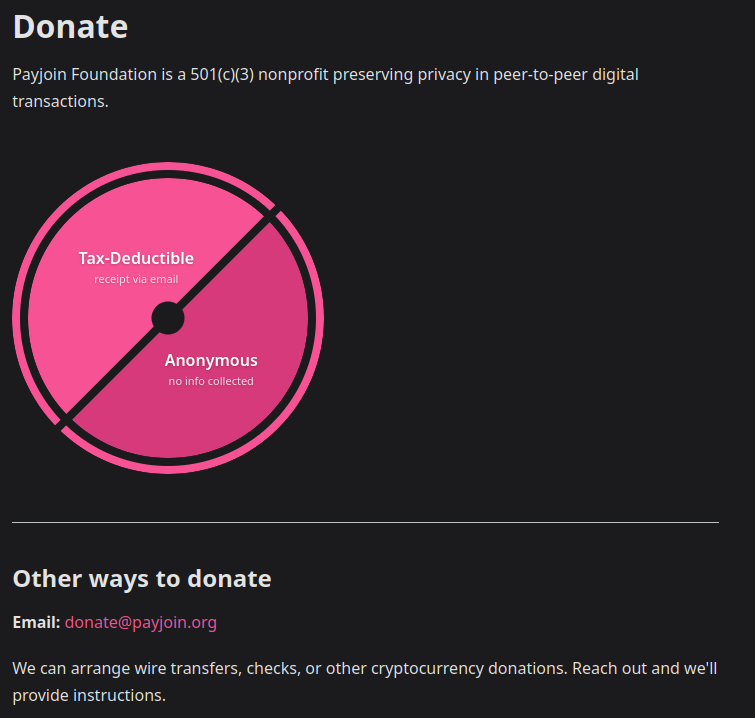
(Headline article below) The Bull Bitcoin Wallet has support for Payjoin transactions, if supported by recipient. Let’s hope this catches on more. The problem with mixing services is that they’re usually expensive, so you have to have a compelling reason to use them, and governments are treating them as suspicious with plans to mark them as tainted to keep exchanges from cashing them out… Greedy authoritative governments not wanting you to have any financial privacy, because they view your money as belonging to them until they can take it from you, e.g. inheritance taxes, confiscating inactive accounts, capital gains soon to become unrealized capital gains… And a new one for me, their donation QR code worked for Bitcoin and Lightning, as when using my Zeus Wallet, it asked with which one I wanted to use, for which I used Lightning (the anonymous option).
https://www.therage.co/payjoin-donations/
The Payjoin Foundation has been recognized as a 501(c)(3), so you can help break the link between Bitcoin payments on chain.
By Joakim Book

This week, the Payjoin Foundation announced that it has received 501(c)(3) recognition from the IRS, formalizing its role as a public charity dedicated to advancing Payjoin and related privacy-enhancing Bitcoin infrastructure.
The Payjoin Foundation was set up to solve Bitcoin privacy problems in non-commercial ways, implementing and integrating BIP-78 standard payjoins everywhere. Other attempts at providing transaction privacy have long suffered from low liquidity, dependence on a central coordinator, or large fees — either in the constituent transactions themselves or via misaligned incentives with the wider ecosystem.
Donations to the Foundation are now tax-deductible under U.S. law, lowering friction for individual and institutional donors. Previously, the Foundation operated via grants and sponsorship from OpenSats and Cake Wallet, among others.
What is a Payjoin?
The open structure of public blockchains like Bitcoin is what makes them strong and verifiable, uncensorable and decentralized. It’s also a weakness that allows anybody to track and trace transactions and produce detailed maps of economic relationships. With enough analytical tooling and comprehensive information, say via KYC information at exchanges or tainted public addresses known to belong to specific entities, sophisticated and comprehensive surveillance can cluster address histories with ever greater precision.
Because transactions are out there, permanently recorded and stored, trying to generate some sort of privacy in the digital age isn’t just fighting against surveillance threats today but for the foreseeable future.
Payjoin is a method for constructing transactions that changes how inputs are assembled in a Bitcoin payment. In a standard Bitcoin payment, one party provides the inputs and another provides the output. That structure makes blockchain analysis comparatively straightforward, and chain-analytics firm routinely assume that inputs spent together belong to the same (wallet) owner.
Payjoin, which work via partially signed Bitcoin transactions (the same feature that underlies multisig), breaks that interpretation by having both sender and receiver contribute inputs to the same transaction, making such assumptions about common ownership completely unfounded. The joint-payment structure can also consolidate UTXOs more efficiently and thus reduce transaction fees and consequently throughput.
It is standard digital hygiene to conceal your transactions in a public and open network. You cover your PIN code when withdrawing cash at an ATM, and don’t wave around wads of cash for everyone to see. In digital environments that expose wealth and spending information by default, it couldn’t be more important to have a now IRS-registered foundation working on such privacy tech.
What’s vital about Payjoin transactions is that they look like any normal Bitcoin transaction. Prior and popular attempts at creating digital anonymity in crowds on Bitcoin, such as Samourai Wallet’s Whirlpool were identifiable (e.g., in uniform denominations), whereas Payjoins still break the basic input-output assumption while remaining undetectable.
Payjoin enables wallets to communicate and create collaborative, smarter, and more efficient Bitcoin transactions. It offers payment batching technology while also promises to economize on fees and enable more transaction throughput on the main chain.
With 501(c)(3) status, the Foundation can now accept tax-deductible donations and operate under formal governance and reporting requirements, indicating that the important privacy-enhancing work is here to stay.