

And we can put a +3 for our computers all running KDE on Arch as well (technically Endeavor OS but basically vanilla Arch underneath). And with KDE saying they’ll drop X.Org support by version 6.8, SonicDE has forked KDE to continue X.Org support, hopefully migrating to XLibre forked from X.Org under the control of IBM/Red Hat. And woke GNOME is trash, though I might try Pop!_OS’s COSMIC fork in Rust one day.
https://linuxiac.com/which-desktop-environment-do-arch-linux-users-prefer/
Which desktop environment and window manager is actually the most preferred choice among Arch Linux users? The answer is inside.
By Bobby Borisov
Arch Linux’s pkgstats data provides one of the few large-scale, opt-in snapshots of how real users configure their systems. While not a perfect census (participation is voluntary), the long-running dataset offers a clear picture of how desktop environment and window managers’ preferences have shifted across more than a decade.
At the same time, the data (to some extent) also reflects a broader trend for one key reason: as you know, a default Arch installation gives you only a base system, and you build everything else according to your own needs and tastes. In other words, there’s no predefined desktop environment that users are locked into, unlike most other distributions.
That means these statistics give us a very accurate look at which desktop environments and window managers Arch users actually choose to install and use. But enough talk, let’s move on to the data.
KDE Plasma Dominates Arch Linux Installations
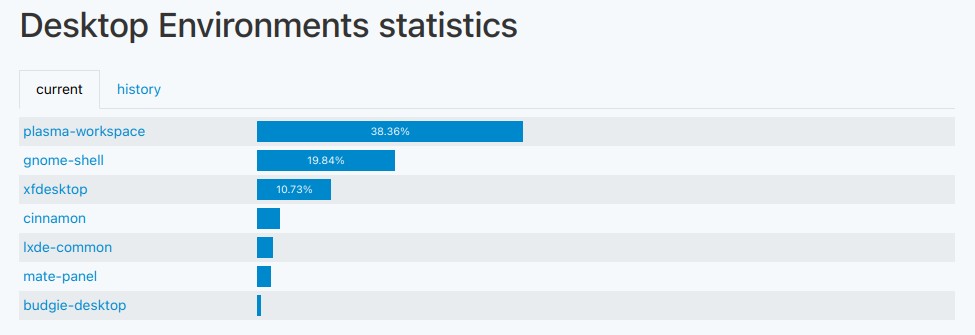
KDE Plasma dominates Arch Linux installations by a wide margin. The latest pkgstats results place the KDE Plasma desktop at 38.36%, nearly doubling the share of GNOME, which sits at 19.84%. This gap has widened steadily over the past three years, marking Plasma’s strongest position in the dataset’s history.
In contrast, GNOME has been on a gradual decline since its peak around 2016–2018, when it consistently held above 30%. Today’s figures show that momentum has decisively shifted toward KDE’s increasingly polished, performant, and feature-rich environment.
Expectably, XFCE takes third place at 10.73%. Its long-term graph reflects remarkable consistency: after a sharp rise during the early 2010s, its share held steadily for nearly a decade before beginning a slow taper. Even so, XFCE remains the most widely used lightweight desktop among Arch users, with a solid double-digit share.
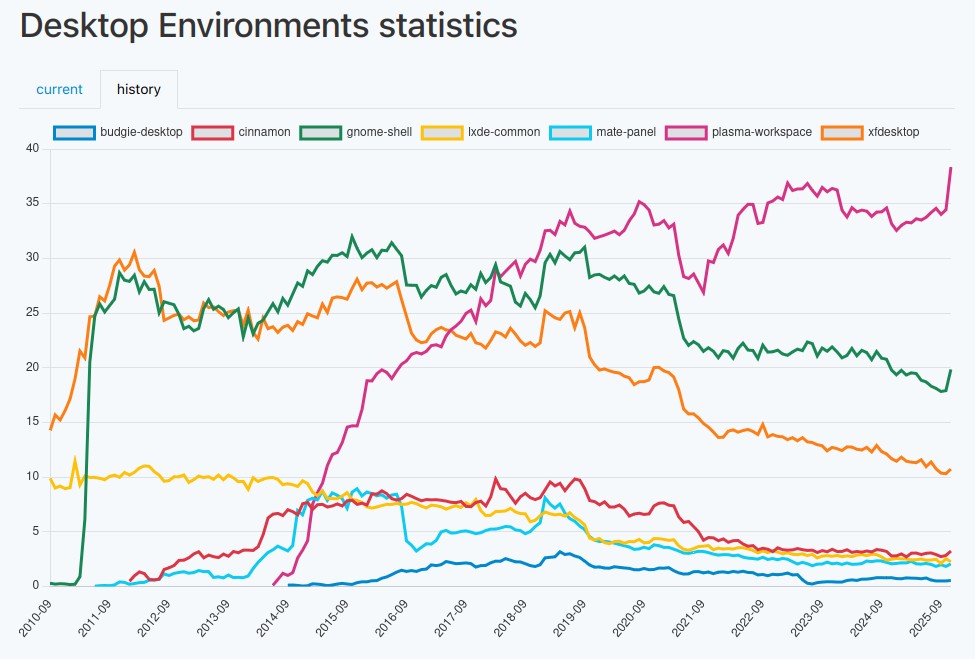
Cinnamon, LXDE, MATE, and Budgie occupy smaller portions of the chart. Cinnamon peaked around the late 2010s but has since trended downward, following the same pattern seen in most non-GNOME, non-KDE desktops. LXDE’s decline is more pronounced, mirroring the project’s shift toward LXQt. MATE and Budgie show small but steady usage, largely unchanged over the past few years.
In short, the data confirms that KDE Plasma has become the clear favourite among Arch Linux users. The reasons for this are beyond the scope of this article, but it can be said that its powerful customization ecosystem appears to have resonated strongly with a user base known for valuing control and technical depth. Now, let’s see how things stand with the window managers.
Hyprland Climbs Rapidly and Challenges Long-Time Favorites
While desktop environments dominate most Arch Linux installations, the pkgstats data for standalone window managers reveals a far more dynamic and competitive landscape.
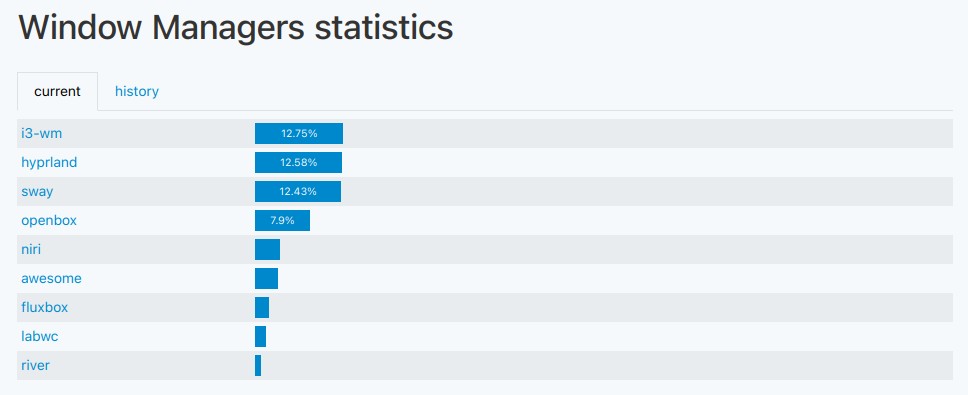
As of December 2025, the latest figures place i3 at 12.75%, Hyprland at 12.58%, and Sway at 12.43%. Statistically, these three are effectively tied, and together they account for more than one-third of all reported window-manager installations. Each, however, reached this position through very different historical trajectories.
i3 has long been a fixture in the Arch ecosystem. Its share peaked between 2015 and 2020, maintaining double-digit usage throughout the past decade. Although i3’s numbers have softened slightly in recent years, it remains the most widely deployed traditional X11 tiler among Arch users. Sway, its Wayland-native counterpart, began gaining traction around 2017 and climbed steadily as Wayland adoption matured. Today, it mirrors i3’s share almost exactly.
The most striking trend in the data, however, is Hyprland’s rapid ascent. Virtually nonexistent before 2022, it surged from zero to parity with i3 and sway in just two years. That growth rate is unmatched by any other window manager in the dataset’s 15-year history. Hyprland’s combination of dynamic tiling, modern animations, high customizability, and a native Wayland focus appears to make it a top choice for Arch users who prefer to bet on a window manager rather than a fully-fledged desktop environment.
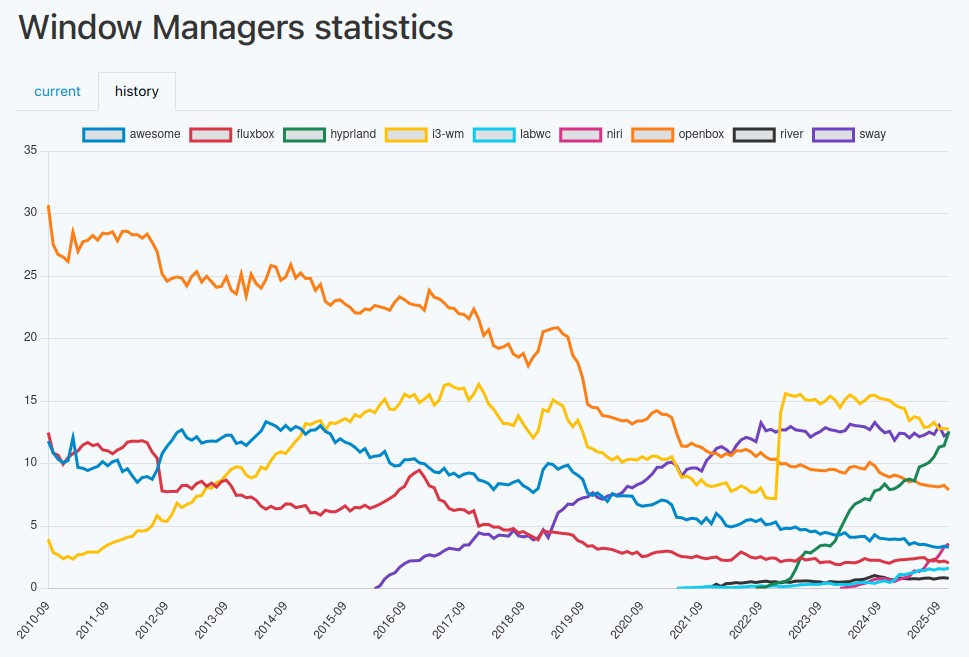
Openbox, once the dominant lightweight choice with a share above 30% in the early 2010s, shows the largest long-term decline. Its usage has steadily decreased for more than a decade, now sitting at 7.9%.
Emerging projects such as Niri, LabWC, and River appear in the lower single digits. While their overall numbers remain modest, their recent upward movement indicates growing interest in newer, Wayland-native workflows. By contrast, older X11-centric managers like Fluxbox and Awesome show mostly declining or flat lines over the past decade, reflecting a gradual shift away from legacy stacking managers toward more Wayland-centric tilers.
Bottom Line
Arch users’ preferences are clear. When it comes to full-fledged desktop environments, KDE Plasma remains the go-to choice, and in the world of window managers, Hyprland is quickly becoming the dominant option. Both trends make sense.
Arch users tend to favor extensive customization, and Plasma delivers nearly unlimited flexibility while offering a modern, visually polished interface. Hyprland, meanwhile, has rapidly built a large following thanks to its striking visuals and fast-paced development, with new features landing constantly.
It will also be interesting to see how things unfold in 2026. Just a reminder: the first stable release of the COSMIC desktop arrives on December 11, and it will probably shake up a landscape long dominated by KDE, GNOME, and Xfce, as COSMIC is expected to draw users mainly from the GNOME ecosystem.
Finally, regarding the data above. It is collected by pkgstats, a utility for Arch Linux that, if enabled by a user, periodically submits a list of installed packages, the system architecture, and mirror information from their system. The data submission is, of course, anonymous: no personal or identifying information is collected.
The website pkgstats.archlinux.de collects these submissions and provides aggregated statistics about what packages Arch users have installed. In other words, it’s effectively a crowd-sourced snapshot of package usage across participating Arch installations. Specific data for the desktop environments is here, and for the window managers here.