

I had been toying with the idea of trying CalyxOS on my phone, though they had an issue with relocking the bootloader and pulled the OS for a time and I went with LineageOS which I’ve been enjoying, with one caveat that you can’t lock the bootloader, though more of an issue if the state got their hands on your device but still giving you a lot of control and privacy from Google/data broker spying… Consequently, I was looking into the Calyx Institute and their advisory board (very bottom) gives me pause, as some of the people look pretty spooky. And the whole thing started with a Ford Foundation donation which is also a red flag. Is this a spook front to lure people away from Graphene OS? And I always thought the phone hotspot membership thing was way too expensive, and was that to lure in possible enemies of the state to the platform so they could keep an eye on them? And these overpriced cellular services that don’t require identification can easily identify you by triangulation and other methods unless you’re incredibly OPSEC minded and are very careful about where you turn it on and use it, though with Flock ALPRs and other surveillance cameras they can probably figure that out pretty easily. Until a reputable security auditing firm checks out the OS code I don’t think I’d trust them.
https://en.wikipedia.org/wiki/Calyx_Institute
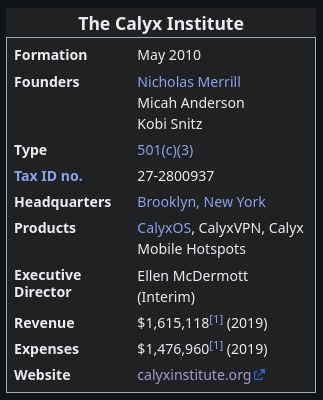
The Calyx Institute is a New York-based 501(c)(3) research and education nonprofit organization formed to make privacy and digital security more accessible. It was founded in 2010 by Nicholas Merrill, Micah Anderson, and Kobi Snitz.
History
The Calyx Institute was founded on May 19, 2010, through a filing with the New York Department of State. Its original office consisted of a single desk in a law firm in Manhattan.
In 2011, Calyx was described in an article in The New York Times and also entered into the Congressional Record as a new non-profit that “aims to study how to protect consumers’ privacy”.[2][3] The same year, The Washington Post described it as an organization that “promotes ‘best practices’ with regard to privacy and freedom of expression in the telecommunications industry” [4] In April 2012, Declan McCullagh at CNET published an in-depth profile of the Institute and its plans to develop best practices and proof-of-concept software for running a privacy-focused internet service provider and phone company.[5] The following month, the security publication CSO Online described the organization’s plan as: “By showing there is a market demand for privacy, The Calyx Institute hopes to nudge telecoms in a positive direction and intends to ‘release all software developed under an open source model as well as all underlying policies and network designs.'”[6]
On December 4, 2014, the Calyx Institute received its 501(c)(3) determination letter from the IRS, giving it the status of “public charity” and making donations to it tax deductible to the extent allowed by law.[7]
In 2017, it moved from Manhattan to Brooklyn, renting office space in the Industry City development.
In 2020, the Calyx Institute was a signer of an open letter asking Google to be more transparent regarding user data being shared with law enforcement.[8]
In 2025, founder Nicholas Merrill left the organization to pursue other projects.[9]
Leadership
The Calyx Institute’s board of directors originally consisted of Nicholas Merrill, Micah Anderson, and Kobi Snitz; in 2016, attorney Carey Shenkman joined the board.[10]
The Institute also has an advisory board, which as of January 2022 consists of Enrique Piracés, Isabela Bagueros, Jonathan Askin, Matt Mitchell, Sandra Ordoñez, and Sascha Meinrath.[11] Past advisors included Brian Snow, Susan N. Herman, John Perry Barlow, and Bob Barr.[12]
Funding
The majority of the Calyx Institute’s funding comes from its membership program. In its early years it received minor funding from Internews, the Wau Holland Foundation, the Ford Foundation, and NLnet.
DuckDuckGo donated $2,500 in 2017 to support Calyx’s mission,[13] and the following year selected it as a participating organization in its Privacy Challenge crowdfunding campaign, through which it raised over $18,000.[14]
The Calyx Institute accepts donations in Bitcoin, which allows anonymity, but requires an email address for acknowledgement if desired.[15]
In December 2022, the Calyx Institute announced it was awarded a $1 million grant from Jack Dorsey‘s #startsmall philanthropy.[16]
Grantmaking
The Calyx Institute has given grants and other financial assistance to a number of organizations and projects including CryptoHarlem,[17] MuckRock‘s Hacking History project, and the Surveillance Technology Oversight Project.[18]
Tools
- CalyxOS is a fork of the Android Open Source Project that aims to give users better privacy and control over their personal data.
- SeedVault is an open-source data backup application for Android. Calyx Institute is credited for LineageOS including SeedVault backup.[19][20]
- Datura is an open-source firewall application built in CalyxOS for controlling the per-app network access.[21]
- Calyx Institute runs CalyxVPN, a free VPN service that does not require an email address or any personally identifiable information from the user. It is based on an open-source system called LEAP, which uses OpenVPN.[22]
- In January 2014, The Calyx Institute announced it had set up a new XMPP chat service, Calyx XMPP Service, at that time unique in forcing the use of end-to-end encryption using off-the-record messaging and leveraging DNSSEC and DANE as well as making itself accessible as a Tor hidden service.[23]
- In 2015, a coalition of organizations consisting of the EFF, the Freedom of the Press Foundation, NYU Law, the Calyx Institute, and the Berkman Center created a website called Canary Watch in order to provide a compiled list of all companies providing warrant canaries,[24] with prompt updates of any changes in a canary’s state. It is often difficult for users to ascertain a canary’s validity on their own and thus Canary Watch aimed to provide a simple display of all active canaries and any blocks of time that they were not active.[25][26]
Conferences
The Calyx Institute has participated multiple times in the DEF_CON hacker conference[27][28][29] and the HOPE conference,[30] and has also participated in the Hackers Next Door conference.[31]
It has also sponsored and presented at the Internet Freedom Festival.[32]
Reception
The Calyx Institute’s membership program provides mobile Internet access as a benefit. This was recommended in September 2016 by Cory Doctorow in an article in Boing Boing entitled “I have found a secret tunnel that runs underneath the phone companies and emerges in paradise”,[33] and in January 2017 by Jake Swearingen in New York Magazine.[34]
Since 2013, the Calyx Institute has been cited as an example of Internet users’ being interested in protecting their privacy and related to Merrill’s successful challenge of a national security letter.[35][36] Its Internet offerings have been called “an exception not the norm”.[37]
In 2019, several Calyx Institute servers were included in a study of the oldest, longest-running Tor exit nodes.[38][39]
In a 2021 review of CalyxVPN, TechRadar called Calyx Institute a “long established non-profit” and said it was unusual in being “powered by donations” without ads and using open-source software.[40]
https://calyxinstitute.org/about/people/advisory-board
Advisory Board
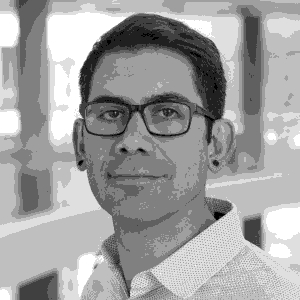
Enrique Piraces is the director of the Technology Program at the Center for Human Rights Science at Carnegie Mellon University. From that role, Enrique focuses on ensuring that emerging technologies can be harnessed to advance accountability, transparency, and justice without jeopardizing the mandate, sustainability, or safety of individuals and organizations involved in human rights work. Enrique has been working at the intersection of human rights, science, and technological innovation for nearly two decades. He is also a partner at Rights CoLab and an advisor to various international organizations.

Isabela Dias Fernandes is the Executive Director of the Tor Project since November 2018. She joined the Tor Project as Project Manager in 2015, after working as Product Manager for International and Growth at Twitter for four years. Isabela has been part of the free software community since the late 90s, and in 2007 she co-founded and worked as Latin America Project Manager for North by South, a startup from San Francisco focused on free software projects. Isabela was also part of Brazil’s Federal Government Free Software initiative, working in 2005 on the Ministry of Communications digital inclusion project and participating in 2006 on a project to migrate the IT of the Presidential Palace of Brazil to free software.

Jonathan Askin is a professor at Brooklyn Law School, with a focus on technology, telecommunications, and entrepreneurial law and policy. He is the Founder of the Brooklyn Law Incubator & Policy Clinic, which provides full service, pro bono, legal support for bootstrapped entrepreneurs, startups, innovators, and organizations, typically exploring ventures and issues the law has not anticipated. He is also the Faculty Chair and Innovation Catalyst for the Brooklyn Law Center for Urban Business Entrepreneurship. Jonathan has served as a Visiting Professor at the MIT Media Lab, a Fulbright Scholar with the University of Amsterdam’s Institute for Information Law, a Visiting Professorial Fellow at the Centre for Commercial Law Studies, Queen Mary University of London, a Fellow at the Columbia Institute for Tele-Information, an Adjunct Professor at Columbia Law School, and Founder/Advisor to iLINC, a network of legal support clinics for the European startup community. Jonathan chaired the Internet Governance Working Group for the Obama ’08 Presidential Campaign, and has served as lead counsel and on the boards of many communications and Internet ventures, industry associations, and consumer advocacy groups. Jonathan is an honors grad of both Harvard College and Rutgers Law School.
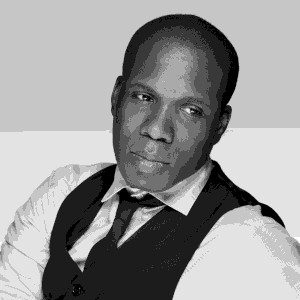 Photo by Nick Lee
Matt Mitchell is a hacker, founder of CryptoHarlem, and tech fellow to the BUILD program at the Ford Foundation. In his work there Matt develops cybersecurity strategy for the foundation’s grantee partners. Matt is a well known security researcher, operational security trainer, and data journalist who founded & leads CryptoHarlem, impromptu workshops teaching basic cryptography tools to the predominately African American community in upper Manhattan.

Sandra Ordonez is the Head of Team CommUNITY, a project of Article19, which provides community and capacity building initiatives for digital rights networks worldwide, and are best known for their flagship event, the Internet Freedom Festival. She has over 20+ years of experience working at the intersection of technology, community engagement, and human rights, and was one of the first Latinas to occupy leadership positions in the open source community, notably having served as the first Director of Communications for the Wikimedia Foundation.

Sascha Meinrath is the Palmer Chair of Telecommunications at Penn State, and a former Vice President of the New America Foundation, where he founded the Open Technology Institute in 2008. He is an expert in community internet and technology policy, with a special focus on rural and Tribal broadband access. He co-founded Measurement Lab, a global broadband measurement platform to accurately test and monitor connectivity — and grown it to become the world’s largest compendium of free broadband measurement data. Previously he founded the Commotion Wireless Project, an “internet in a suitcase” mesh wireless R&D project to provide local communities with their own networks.