

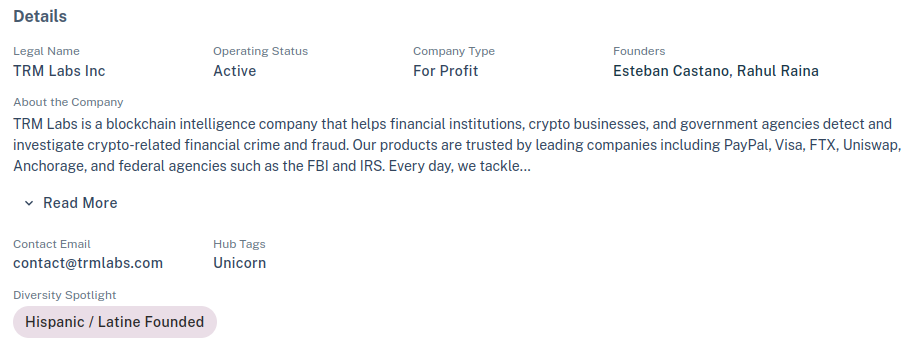
This firm TRM Labs Inc is very interesting for the seeding rounds, investors and megacorp contract connections along with minority founding, which I’m sure is a big benefit in getting federal contracts. And they seem to be hiding this within bureaucracy and away from federal prosecutors.

The $95M contract is awarded by an ICE task force that replaced a federal enforcement program “in favor of.. military strikes against alleged drug smuggling vessels,” according to the man who ran it.
By L0la L33tz
Chainalysis Government Solutions is suing one of its biggest clients – the United States Government – over a $95 Million Dollar Immigrations and Customs Enforcement (ICE) contract awarded to Chainalysis rival TRM Labs.
On June 8th, the Department of Homeland Security published a statement intending to sole-source blockchain surveillance services from TRM Labs, giving competitors just three days to match TRM’s offer.
Unfair, Chainalysis now seems to say, though the majority of the case – including the original complaint – are filed under protective order for trade secret safekeeping.
The contract makes up for about three-quarters of all contracts ever awarded by the United States to any blockchain surveillance firm, with Chainalysis lying at a total of $35 Million Dollars, and TRM Labs now significantly ahead with a total of $128 Million Dollars in US contract obligations.
Though the much more interesting question seems to be, why is ICE of all agencies awarding the largest ever issued contract for blockchain surveillance services at all?
Services Included
According to the statement of need, the contract is intended to fulfill services for the Homeland Security Task Force (HSTF), the National Coordination Center (NCC), and the Cyber Disruption Center (CDC) under Executive Order 14390 – meant to combat cybercrime, fraud, and “predatory schemes against American citizens.”
“CDC faces persistent and evolving threats from cyber-enabled fraud, ransomware, and sextortion, which target critical infrastructure, financial institutions, and vulnerable populations,” Homeland Security says. “To address these challenges, HSTF requires a team of analysts equipped and skilled in cryptocurrency tracing, blockchain analytics, and open-source intelligence tools to identify criminal activity across multiple cryptocurrency blockchains.”
The statement of need names combating sextortion, scams, and and general cybercrime as the CDC’s goals. Additionally, the notice states, “NCC also requires the ability to scale operational capacity rapidly to support surge events, special operations, engineering initiatives, or new partnership activations.”
Services to be rendered include the clustering of criminal syndicates, real-time scam wallet screening and the targeting and mapping of transnational criminal organizations, threat graphs for cybercrime, the targeting and mapping of criminal networks and infrastructure operators, as well as international field engagement and monitoring.
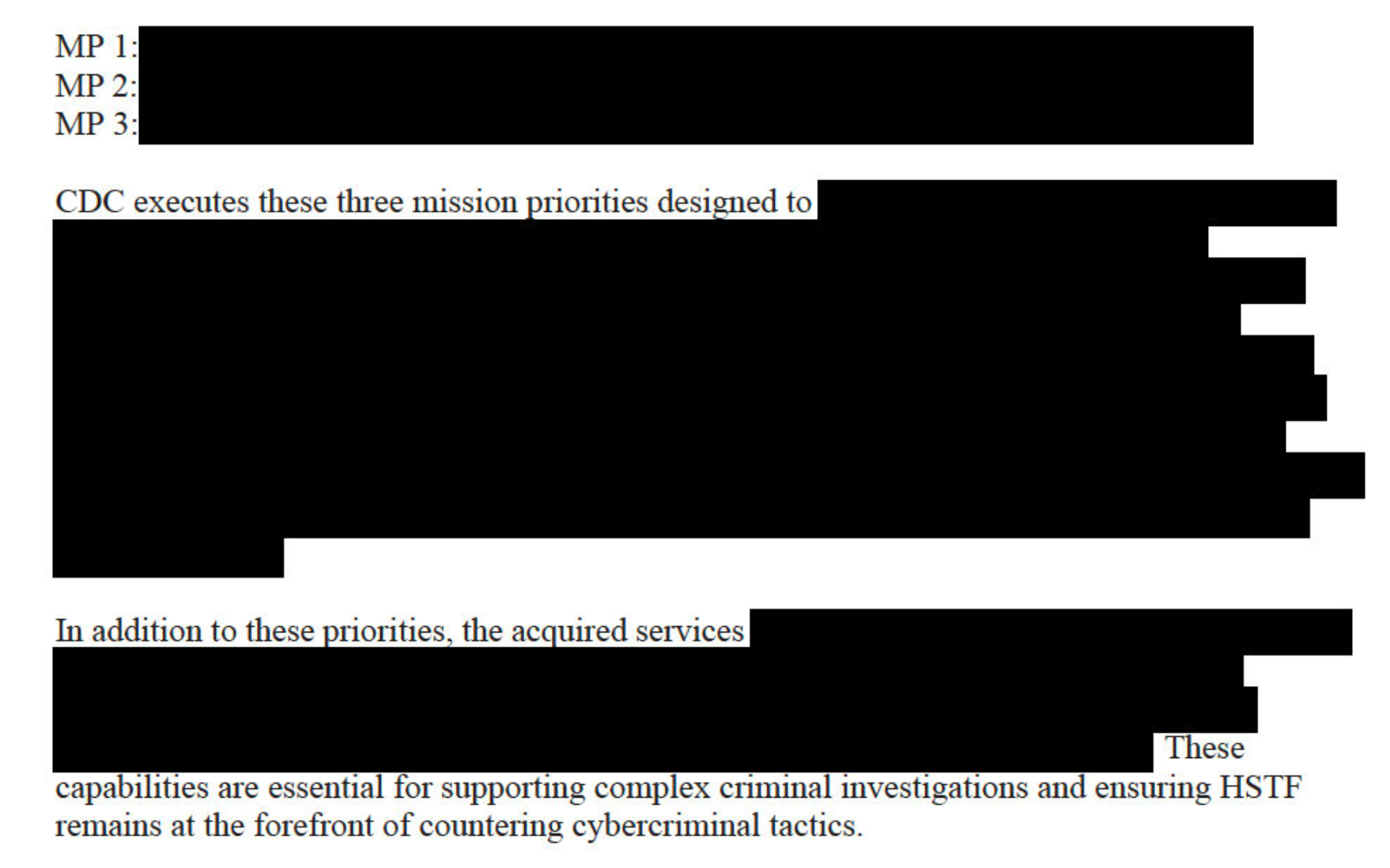
The CDC’s mission priorities have been fully redacted within procurement records.
“We Don’t Negotiate. We Dismantle.”
Stopping cybercrime, of course, is an honorable goal, no matter what you think of blockchain surveillance tech – But what does ICE have to do with it? ICE is home to Homeland Security Investigation’s Cyber Crime Center (C3) – but it appears unrelated to the CDC the contract is meant for.
In January 2025, Donald Trump issued an Executive Order titled “Protecting the American People Against Invasion,” that resulted in the formation of 30 permanent task forces within the Department of Homeland Security.
The HSTFs are co-led by the Department of Homeland Security and the FBI, whereas Homeland Security has delegated its governing part to Homeland Security Investigations; the law enforcement arm of ICE, and the second largest investigative agency in the US.
Notably, the HSTF’s Cyber Disruption Center (CDC) appears to have no dedicated website, nor are cyber disruption capabilities listed as a core responsibility on the HSTF’s page. In effect, it appears that the CDC does not exist in the public view beyond procurement records at all.
Officially, the HSTFs cover six areas: narcotics & contraband, human trafficking & smuggling, weapons trafficking, financial crimes, transnational gangs, and intelligence fusion – areas which usually fell under the jurisdiction of the Organized Crime Drug Enforcement Task Forces (OCDETF); a 40 year program that the DOJ discontinued to be replaced with the HSTFs in 2025.
“The termination of DOJ’s OCDETF program comes as the Trump Administration ceases the United States’ lawful maritime drug interdiction mission in favor of its questionable use of military strikes against alleged drug smuggling vessels,” writes former OCDETF Director Thomas Padden.
“The HSTF model eliminates the role of prosecutors in creating and coordinating task forces, and criminal enterprise investigations that include financial investigations are no longer a priority,” Padden continues. “The termination of OCDETF undermines the role of federal prosecutors as coordinators of criminal enterprise investigations and weakens law enforcement by eviscerating DOJ’s ability to dismantle sophisticated transnational criminal networks.”
“Without prosecutorial oversight, information sharing between law enforcement, the Intelligence Community, and the military is unclear and the potential for mismanagement of the process is increased,” Padden told Congress in March.
A Task Force Away from Public View
Since the beginning of Trump’s second term, the US Military, under leadership of SOUTHCOM, has bombed several fisher vessels in Latin America alleged of having acted as narcotics traffickers. Due to the lack of due process applied, human rights organizations have largely described the bombings as “extrajudicial killings” that “amount to war crimes.”
What intelligence SOUTHCOM uses to target the vessels remains unclear, and is currently subject to investigation by the Pentagon’s Inspector General. What is clear is that the former agency in charge of targeting transnational criminal organizations is no more, having been replaced with the same web of task forces that now got unprecedented access to blockchain surveillance tools.
ICE’s Homeland Security Investigations itself has long been criticized for its broad mandate to “investigate any federal crime,” having been implicated in monitoring lawful protests and dragging protestors into unmarked vans, the unproportionate targeting of people of color who are not suspected of criminal activity, and the unrightful painting of immigrant youth as gang members.
In 2023, Senator Ron Wyden called for an investigation into HSI for obtaining Millions of records of money transfers exceeding $500 Dollars, describing the collection as “mass surveillance.”
ICE is currently spending record amounts on surveillance tools to target immigrants. Whether the contract for blockchain surveillance services will stay with TRM Labs, or if it may need to undergo a new awarding process, remains unclear. Oral arguments are set for September 2.
TRM Labs has joined the case as a voluntary co-defendant on behalf of the United States.