

The Windows 10 that was supposed to last forever debacle pushed many people to Linux. Throw in the complete tracking of people on Windows 11 with their GDID along with Apple and their ID system, and people concerned with privacy as the world heads towards digital ID, should continue to adopt Linux as their operating system. I’ve rejected all closed source operating systems, even moving to opensource LineageOS on my smartphone (there are even more private options like CalyxOS and GrapheneOS depending on hardware). So there is no longer a need to run operating systems from tech megacorps that don’t respect you.
https://linuxiac.com/linux-desktop-market-share-surpasses-10-in-north-america/
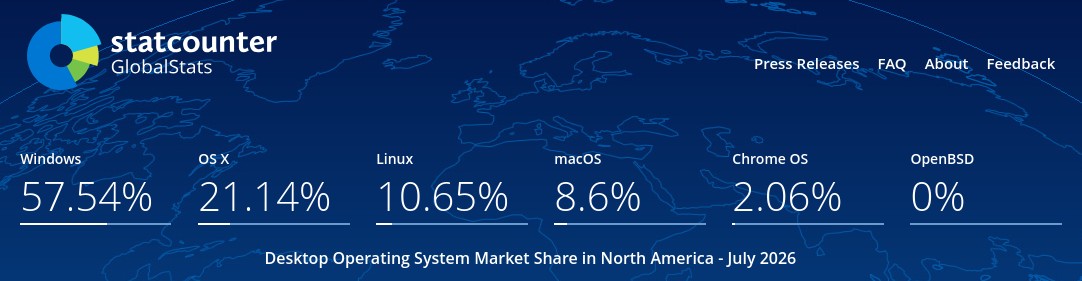
Statcounter reports Linux at 10.65% of desktop usage in North America, with Cloudflare data lending further support to the milestone.
By Bobby Borisov

Linux has crossed a major milestone in North America, with the open-source operating system now accounting for 10.65% of desktop usage in the region, according to Statcounter’s latest figures for July 2026.
The result places Linux firmly in double-digit territory for the first time in Statcounter’s North American desktop operating system statistics.
For comparison, Statcounter recorded Linux at 5.52% in June 2026, so the share nearly doubled in one month. As expected, Windows remained the dominant desktop operating system, while Apple’s OS X and macOS categories continued to hold a substantial market share.
However, the sharp monthly increase needs context. Statcounter’s June figures included an “Unknown” category that accounted for 9.24% of North American desktop usage. Its reduction seems to have coincided with Linux’s rise, possibly indicating better identification of previously unclassified traffic.
That does not invalidate the 10.65% result, but the increase should not be seen as millions switching from Windows or macOS to Linux in July alone. Part of the jump may reflect changes in detection, classification, or Statcounter’s sample composition.
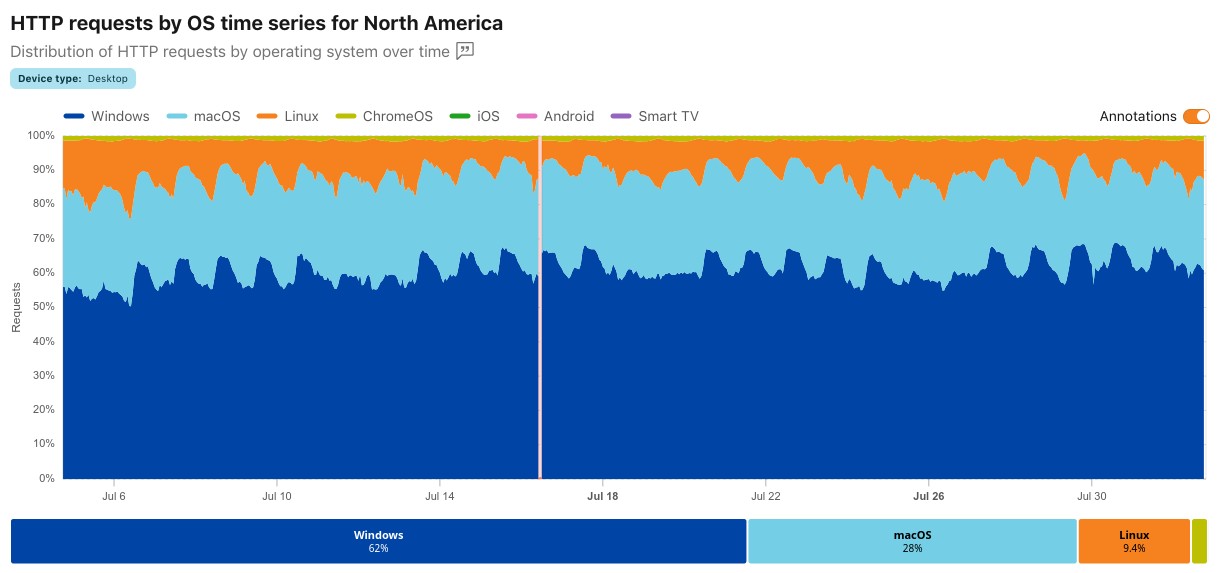
Still, Statcounter is not the only major web measurement platform showing Linux with a substantial presence on North American desktops. Cloudflare Radar data, filtered to desktop HTTP traffic from North America over the previous 28 days, also places Linux at a notably high level.
Importantly, the two services use different datasets. Statcounter bases its statistics on page views from its analytics network, which covers over one million websites and processes more than three billion page views monthly.
The company measures usage by page views rather than counting unique users or installed systems. Its figures update daily and may be revised during a 45-day quality-assurance period.
Cloudflare Radar, meanwhile, derives its operating system distribution from HTTP requests observed across Cloudflare’s global network.
Consequently, neither source should be seen as a literal census showing exactly one in ten North American desktops run Linux. They just measure the relative share of observable web activity linked to different operating systems.
Cloudflare’s unfiltered figures may include automated requests unless human traffic is classified. This is especially relevant to Linux, widely used for servers, automation, development environments, and headless browser workloads. Still, two large independent datasets pointing to a stronger Linux desktop presence make the Statcounter result harder to dismiss as an anomaly.
The milestone comes after years of steady improvements in the Linux desktop ecosystem. Hardware compatibility has advanced, installation has become simpler, and mainstream distributions now offer polished desktop experiences requiring little command-line knowledge for everyday use.
Linux gaming has transformed through Valve’s Proton compatibility layer, the Steam Deck, improved graphics drivers, and broader Vulkan support. Meanwhile, growing frustration with Windows hardware requirements, advertising, account integration, telemetry, and forced interface changes has pushed some users to explore alternatives.
However, none of these factors alone proves the cause of the latest increase, and Statcounter does not provide demographic or motivational data to explain the change. Still, they are part of a broader environment in which moving to Linux is more practical than it was a few years ago.
The Steam Deck may have also contributed indirectly. Although primarily a handheld gaming device, its Linux-based SteamOS has introduced a larger audience to Linux gaming and shown that the operating system can deliver a polished consumer experience without requiring users to understand technical details.
There is also growing influence from developers, privacy-conscious users, educational institutions, and organizations seeking greater control over computing environments. Plus, Linux distributions increasingly provide mature support for productivity workloads, web applications, communication platforms, creative software, and development tools.
For now, the safest conclusion is that Linux has surpassed 10% of measured desktop web usage in North America according to Statcounter, not necessarily 10% of the region’s installed desktop computer base.
But even with that distinction, crossing the double-digit threshold remains notable. Linux has spent decades described as perpetually close to a desktop breakthrough. So, maybe, just maybe, we’re really approaching a famous running joke and long-standing prediction: “Year of Linux on the Desktop.”