

This report reminded me of the road up to the Livermore Observatory in California, as it was pretty windy and narrow with not much shoulder, also having switchbacks. And I had one of the neatest experiences on that road, as I came around a corner on my sportbike to a Coyote with the most amazing eyes standing in the opposite lane, and I came to a stop about 10 feet away. Us just looking at each other for a couple minutes, but when I went for the camera in my tank bag he got nervous and took off. I thought he might of just broke off chasing something as he was breathing pretty heavy and not in a hurry to move. I’ll never forget it, and exploring on a motorcycle leads to many such experiences. And for this story below, a couple other factors that could impact riders is temperature and altitude impacting their reflexes and cognition.
Agencies in Wyoming and Montana say they have been responding to an unusually high number of motorcycle crashes on the Beartooth and Chief Joseph highways. They blame speed, weather, distracted driving and lack of experience on winding roads.
By Andrew Rossi
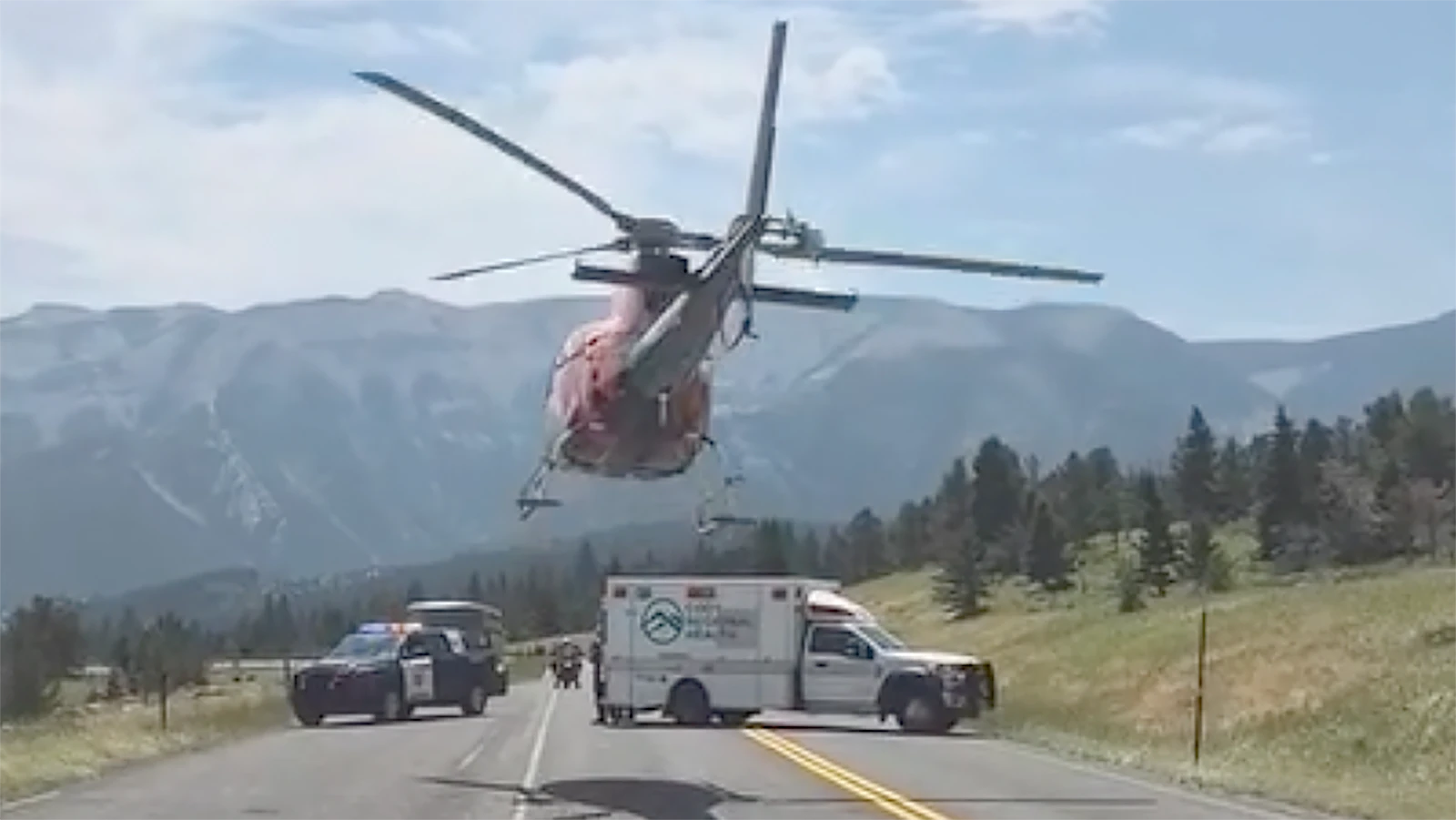
Too many motorcycles are crashing in northwest Wyoming. Law enforcement officers and first responders wish they’d stop.
Multiple agencies in Wyoming and Montana have been responding to an unusually high number of motorcycle incidents on Wyoming 296, the Chief Joseph Scenic Highway, and U.S. 212, the Beartooth Highway.
It’s been enough that Park County Fire District 2 issued a statement urging motorcyclists to “consider the challenges” before embarking on the narrow, winding mountain passes.
“This stretch of road is one of the most beautiful in Wyoming, but right now, it’s also one of the most unpredictable,” said Jerry Parker, administrator of Park County Fire District 2. “Wyoming’s mountain passes are unforgiving!”
Injurious July
Aaron Brown, spokesman for the Wyoming Highway Patrol (WHP), was still compiling crash statistics from Wyoming 296 and U.S. 212 on Friday. It was difficult to get a hard number because multiple agencies responded to several different incidents, he said.
From the data available, he said there’s “definitely been an increase” in motorcycle incidents on both stretches of highway. They’ve responded to at least 13, most involving motorcycles, between both highways in the last month.
“The WHP has seen five motorcycle crashes on the Beartooth Highway this year, and all of them have been in July,” he said. “A few had minor injuries and at one reported had serious injuries, but no fatalities.”
Colloquially, Brown has heard about the increase in motorcycle crashes from WHP troopers stationed in northwest Wyoming. The number of incidents has risen to a noteworthy level.
“One trooper was telling me they’ve heard reports of even more motorcycle crashes up there,” he said. “We don’t have all the reports because some of those were county responses.”
Multiple Factors, Same Result
According to Brown, multiple factors contributed to these crashes, but the result has been the same.
“It tends to be lane usage,” he said. “In other words, (motorcycles) are coming around a curve, and they’re not making their lane, missing the lane and going off the road, not negotiating a turn correctly, or swerving and not staying on the road.”
These factors are a problem for motorcycles on all roads, but the tight curves on Wyoming 296 and U.S. 212 are especially hazardous.
Brown said one exacerbating factor is the lack of a shoulder along these highways, particularly the switchbacks drivers must take to ascend and descend.
“On the Beartooth Highway, the white line is the shoulder,” he said. “You don’t really have a shoulder to speak of, so when you hit that white line, which you might if you aren’t ready for it, you’ll just go off the road.”
Weather is another important consideration. There have been afternoon and evening thunderstorms in northwest Wyoming every day for the last few weeks, which can quickly make the pavement slick and dangerous.
For Brown, using “curves” to describe these mountain passes might be too generous.
“From a bird’s-eye view on the map, it looks less like curves in the road and more like an EKG reading,” he said. “These are sharp, narrow curves.”
Too Beautiful?
When it comes to fatal accidents in Wyoming, speed is the top contributing factor. Second place, according to Brown, is distracted driving.
That’s where the natural beauty of the Beartooth and Chief Joseph Highways might be contributing to the rise in motorcycle crashes. Brown said he thinks it’s more than a possibility.
“Motorcycle drivers might not be looking at their phones, but they’re out in the open air, enjoying the ride on the most beautiful highways in the entire nation. You can get distracted by the beautiful landscape. A motorcycle on those curves, especially at highway speeds, can’t afford to get distracted.”
One of the allures of these highways is how remote and untouched by civilization they feel. That, too, can be a detriment.
Large portions of these highways have no cellular service. That makes it hard to notify first responders when an accident occurs, adding more time to an already difficult and time-consuming response. ‘
“Every second counts when it comes to these serious calls,” Brown said. “We have to switch to conventional radio towers and satellite phones just to communicate, and when you need a life flight, it can be difficult to get that message out.”
Know Your Limits
The 86th Sturgis Motorcycle Rally starts Aug. 7 in South Dakota. Thousands of motorcycle enthusiasts will be traveling there from across the country and often take a detour across the Beartooth and Chief Joseph Highways on their route.
Parker and Park County Fire District 2 urged motorcycles to use extra caution in northwest Wyoming: Slow down through curves and blind corners, pull over during storms or low visibility, and always be alert and aware of other drivers, livestock, and wildlife.
Brown believes there’s another essential safety consideration that might be contributing to these crashes. The best way for motorcycle drivers to proactively prevent crashes is to be honest with themselves before heading out.
“I think, at the end of the day, we’re seeing a lot of riders trying to go outside of their skill set,” he said. “That’s not to say they’re not good enough to do the Beartooth and Chief Joseph, but they need to ride within their skills.”
As alluring as these mountain passes might be, they also might be too much for even experienced riders to handle. Brown believes many don’t anticipate the number of sharp turns they’ll encounter, one after another, along the way.
If a motorcycle is already going too fast, an unexpected curve can quickly lead to a crash and serious injury.
“The number of sharp curves might be beyond what a specific biker may be willing or able to do at their skill level,” he said. “There’s a general dangerousness to those curves, especially if there’s no shoulder.”
Anyone can safely enjoy the Beartooth and Chief Joseph Scenic Highways on a motorcycle, but these routes are inherently challenging, even for experienced drivers, Brown said. He hopes more drivers will consider themselves and their abilities before taking any risks.
“If you’re going to do the Beartooth or Chief Joseph, ride within your skills and slow down,” he said. “It’s not a place you want to be crashing out on.”