

This is promising, but there are too many captured lawmakers in the Wyoming state legislature with too much money behind them. The megacorps abusing our data, along with the federal government, are not going to let this happen without strong and cunning resistance. And though a supporter of law enforcement, I’m deeply disturbed that they are advocating for and installing ALPR cameras and signal receivers to track all citizens, violating our fourth amendment rights while being too vocal against those trying to reign it in, including heir accomplices in local government. If they continue to be bad actors, budget limitations for such technology and methods would be appropriate while voting out any government officials violating constituent’s privacy along with removing law enforcement officials who have forsaken their place and advocated against citizens. And with our lower population numbers, there are voting consequences and big tech and the federal government will have to sacrifice assets to accomplish their agenda.
Wyoming legislators are working on a bill to give Wyomingites property rights over their own personal data — and another to restrict license plate reader usage. “It would be far and away the strongest privacy right on the planet,” said a lawmaker.
By Clair McFarland
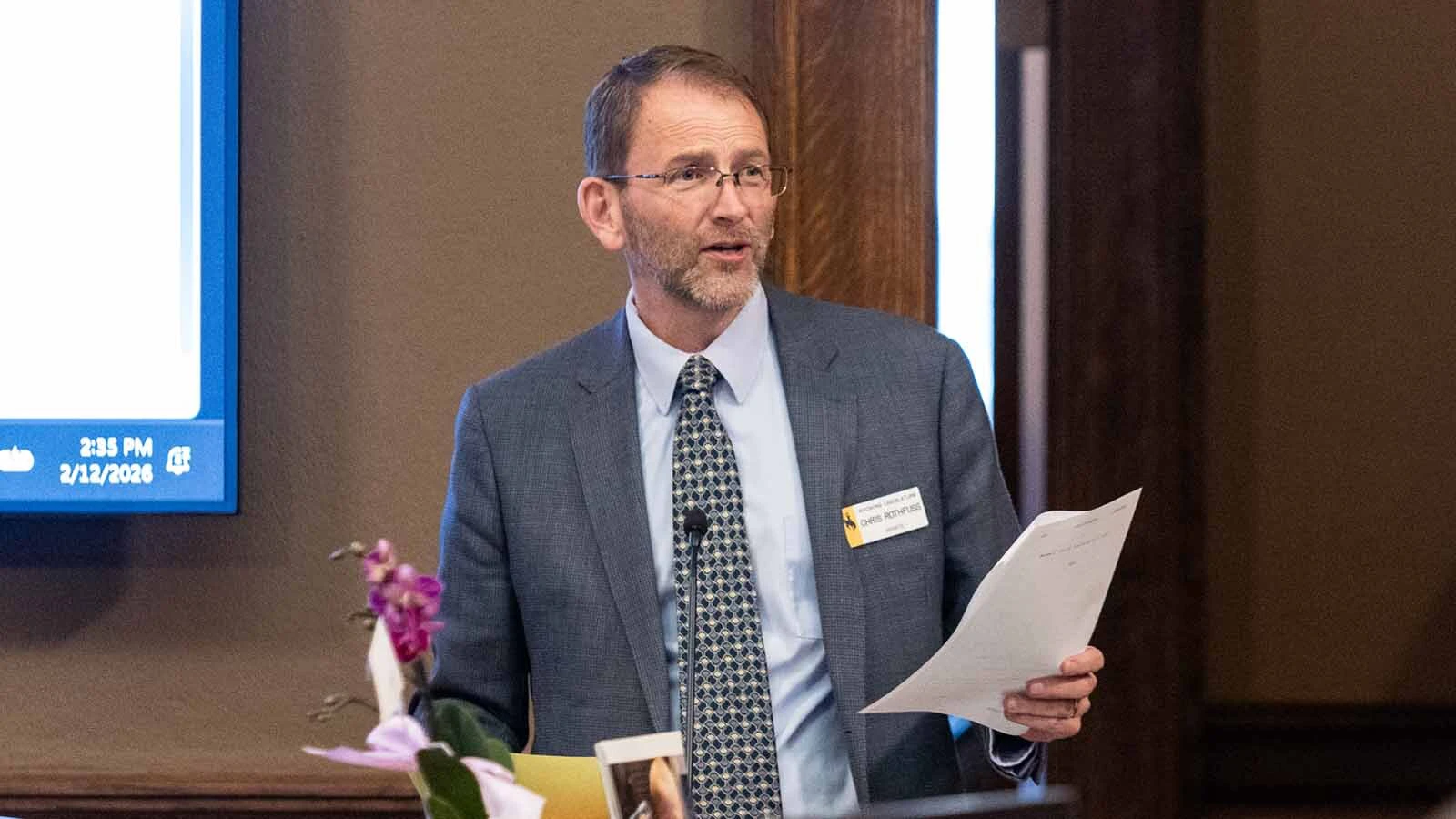
Wyoming legislators say they’re working on a groundbreaking bill to give Wyomingites property rights over their own personal data — and another bill to restrict license plate reader data usage.
The vow intersects with rising concerns about license plate reader cameras like Flock, Motorola and other brands operating in some Wyoming communities.
It also follows eight years of a tech-oriented legislative committee’s work to safeguard people’s personal data from being indiscriminately sold on internet channels.
Both bills are set for a more thorough hearing at the University of Wyoming during the Sept. 28-29 meeting of the Select Committee on Blockchain, Financial Technology and Digital Innovation Technology.
If it passes, the data privacy bill would be “the first of its kind in the world,” Committee Co-Chair Sen. Chris Rothfuss, D-Laramie, told his colleagues during a Wednesday meeting in Casper.
“There’s nothing even close. It would be far and away the strongest privacy right on the planet,” said Rothfuss. “I’d love to be the state that does it, if we can get there.”
But Rothfuss warned the other lawmakers to prepare for immense backlash from the tech private sector.
“If we implement it, candidly, it will make a lot of companies mad,” he said.
Data Would Be Your Property
None of that fury descended on the public comment segment of Wednesday’s meeting. Rather, a few proponents offered suggestions and feedback.
That’s because this was only the unveiling of the bill, said Rothfuss in a Thursday phone interview.
He said he’s spent significant time this year tuning the bill, titled the Wyoming Personal Data Ownership Act, to account for property-rights scenarios across the legal spectrum.
It’s unique because rather than codify consumer protections pertaining to social media or other vendors’ products, it proclaims that a person’s data is his or her own property, said Rothfuss.
That means the government’s request to use someone’s data would function like an easement; a private company would have to get permission to borrow it.
“Unauthorized processing or possession of personal data is an interference with the data owner’s exclusive rights and a concrete and particularized injury,” says the bill draft.
Those breaches resemble trespass or conversion, the draft adds.
Some Carveouts
The bill contains carveouts as well.
For example, a media outlet could still use a photograph of someone in reporting. People can use available data in communication, commentary, criticism, analysis, scholarship, indexing, discovery, preservation, or creating expressive work, under the bill.
But none of those uses could involve “commercial exploitation” of individualized information.
Sensitive data would fall under a more stringent category than personal data. Some of that, like genetic and neural data, and personal data for kids under 13, would be barred from use as a “commercial instrument.”
People’s biometric identifiers and precise geolocation couldn’t be used without affirmative consent, and then for no more than one year. The government would have to get a warrant on probable cause to access those.
People’s data on personal health, religious beliefs, political affiliation, financial accounts and any personal data of teens would require affirmative consent and be capped at a year’s use as well. But the government would only need a “court order on judicial review” for access.
All other personal data could be used for up to two years but not retained for more than three years, and could be pulled into the legal process through a subpoena.
People could demand companies delete their data “at any time” if this bill passed.
If an active access authority or a law precluded that, the entity using the data would have to let the person know within 30 days of the demand for deletion.
The committee’s co-chair from the state House side, Republican Rep. Daniel Singh of Cheyenne, told Rothfuss on Wednesday that he supports the groundbreaking bill.
Next Up, License Plate Readers
Singh presented a bill that sought to restrict license plate reader usage as well as biometric and geolocation data usage.
Under the bill as drafted Wednesday, law enforcement agencies could only access biometric or geolocation data for investigating violent felonies, upon probable cause; helping to find a missing or endangered person; or helping to identify a person believed to be dead.
All those causes would still require a warrant.
Law enforcement agency representatives opposed the bill vocally, with most lamenting that all those topics were lumped into one bill.
Singh acknowledged the bill is broad.
“I think we’re actually holding in our hand, like, four or five different bills,” he said. “We may need to divide and conquer.”
Rep. Mike Yin, D-Jackson, suggested tackling the license plate reader controversies this year, and addressing the biometric data part until a later session cycle.
Rothfuss agreed.
Wyoming Division of Criminal Investigation Commander Ryan Cox had listed numerous active, and some mandated, uses for biometric data.
Law enforcement agencies take fingerprints and palm prints when registering sex offenders. Fingerprints are part of background checks for numerous entities, including those bringing in volunteers or employees to work with kids.
Cox noted that in disaster scenarios like floods and tornadoes, law enforcement wouldn’t be able to get a warrant to identify a decedent as the bill contemplates, because those aren’t crime scenes.
Sheridan Police Chief Travis Koltiska said that a lot of crimes not classed as violent felonies are still considered public safety risks, like stalking, domestic violence, protection order violations fraud and identity theft.
Cox referenced child pornography crimes as well, which, though “horrific,” aren’t classed as violent felonies.
Devon Brubaker, director at Southwest Wyoming Regional Airport, said airports will use license plate readers — but not tap them into the larger LPR networks lately causing concern — for parking verification uses.
They’re also trending toward using biometric data, and may need to use it to comply with U.S. Department of Homeland Security and other federal safety requirements, he said.
What Are Private Companies Doing?
Rothfuss told law enforcement agency representatives that his key concern is what private companies are doing with the license plate reader location data that they gather for law enforcement.
“Your mission is to serve and protect. Their mission is to make money off data,” he said. “And there’s our challenge.”
Allen Thompson, director of the Wyoming Association of Sheriffs and Chiefs of Police, quipped that “might be why some of them are offering a very cheap service to law enforcement.”
Rothfuss parried: “You’re either the customer or you’re the product.”
James Halverson, deputy state director for Americans for Prosperity, acknowledged that the bill needs work, but said his group is in favor of the concept.
Sen. Barry Crago, R-Buffalo, worried aloud that the Legislature could run afoul of constitutional provisions by restricting private companies’ data-gathering ability altogether.
This fell under the context of location points and vehicle images shot by license plate reader cameras. Crago gave the example of trying to stop a person sitting with a camera, filming activity on a public highway.
“We can limit the government from contracting with those third parties, but I question, can we constitutionally limit the third party from recording the data, keeping the data — and if so, what does that look like?” asked Crago.
Rothfuss referenced the property rights bill he presented at that meeting, saying that could be a “hook” to protecting data, “but it takes a couple of interesting steps.”