

This is nuts. And you have to remember that the EU governmental body are unelected bureaucrats that make and enforce decisions on the member nations. And these rules kind of point out what a OCGFC scam the EU is, and how they control it. And Chat Control 2.0 is leading towards agentic AI being required on your device to read messages before you encrypted ap sends them. Consequently, this reminds me of the Upper Echelon video on the $20 million dollar “heist” in a dumb DAO crypto project which was due to even worse rules and voting (it’s so ridiculous you have to see it).
https://reclaimthenet.org/eu-brings-back-chat-surveillance-even-as-more-meps-vote-no
Every empty chair in Strasbourg counted as a vote for the surveillance nobody in the room had the numbers to stop.

By Dan Frieth
Europe’s biggest platforms can once again scan your messages without a warrant or any reason to suspect you of anything. The European Parliament revived a mass-surveillance regime on Thursday that its own members had already voted down in March, and it passed even with fewer MEPs backing it than opposing it.
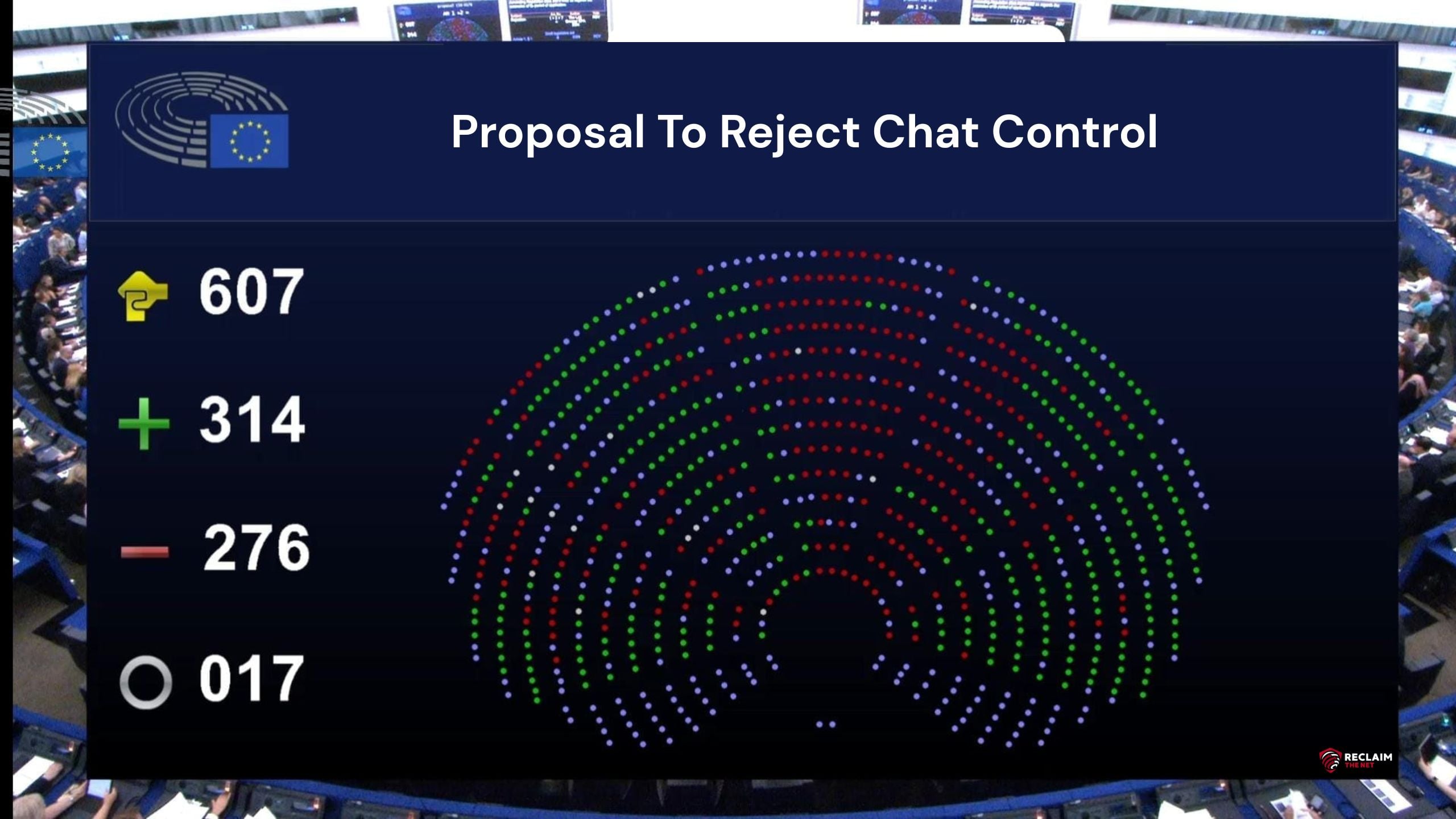
The count on the measure known as Chat Control 1.0 came in at 314 against, 276 in favor, and 17 abstentions. More members voted to kill the regulation than to keep it, and it became law regardless, a version of democracy that would surprise most of the people living under it.
Because the European People’s Party forced the proposal back as a second reading, blocking it no longer took a simple majority of the room but an absolute majority of the entire Parliament, 361 of all 720 seats, counted whether a member turned up or not.
That threshold made absence decisive. The vote landed on the final sitting day before summer recess, a date when much of Parliament has historically already left Strasbourg for home, and under an absolute-majority rule every empty seat weighs against the side trying to reach 361. The 314 who showed up to reject the regulation were not outvoted by a larger camp in favor, since only 276 wanted it. They fell 47 votes short of a bar set by the size of the whole chamber rather than the size of the vote.
The contrast with the spring tells the rest of the story. When Parliament last ruled on this in March, defeating the extension needed only a simple majority, and 311 against, 228 in favor, with 92 abstentions, was enough to sink it and let the regime lapse in April. This week a slightly larger bloc, 314, voted the same way and lost. The will of Parliament did not shift between March and July. The procedure and the calendar did and that was enough to overturn the result.
Arithmetic handed the tech industry the outcome it wanted. Warrantless scanning of private communications is legal again across the bloc until 2028. Parliament did attach an exemption for encrypted communications, a gesture that costs nothing given that providers were not scanning encrypted chats anyway. A more substantive attempt failed. A move to restrict scanning to people a court had already flagged as suspects drew even stronger support, 322 to 255, and still collapsed against the same 361-vote wall. What survived was the broadest, most industry-friendly version on offer, one that monitors everyone’s messages by default and asks judicial permission for none of it.
Dr. Patrick Breyer, civil rights activist and former Member of the European Parliament, sent a statement to Reclaim The Net. “The fact that Chat Control is moving forward against the will of the majority of voting MEPs is a farce and damages democracy. Our children are the real losers in this undemocratic process. The passage of a genuine, permanent child protection regulation is now in serious jeopardy. The Council will never agree to a desperately needed paradigm shift as long as they can simply stick to the old approach of suspicionless scanning at the whim of the tech industry.”
He framed the loss as temporary. “Today’s vote on the interim regulation was a setback, but the political battle over the permanent ‘Chat Control 2.0’ is just getting started. The resistance we saw in Parliament today was so strong that finding a majority for permanent, suspicionless mass scanning in future negotiations is a complete pipe dream.”
His objection actually runs deeper than mere procedure. “Trying to protect children with suspicionless mass surveillance is like frantically mopping the floor while the faucet is still running. Blanket chat control is just as unacceptable as indiscriminately opening everyone’s physical mail. For five years, this failed system has served as a smokescreen to delay real action, all while overwhelming the police with false alarms. We need more child protection, not less—but we need effective protection, not the illusion of security.”
The reinstated regime holds until 2028 or until governments and Parliament agree on a permanent replacement, with negotiations set to resume in September. The dispute there turns on a single question that has divided Parliament, the member states, and the Commission for years, which is whether the scanning of private chats should cover everyone or reach only criminal suspects.
US companies regain permission to scan private messages with no warrant and no prior suspicion, covering direct messages on Instagram, Discord, Snapchat, Skype, and Xbox, along with email through Gmail and iCloud. A good deal stays untouched by the vote, because public social posts and cloud-stored files were already scannable without this law, and authorities could always act on user reports or seek a court-ordered wiretap aimed at an actual suspect.
The case for calling any of this child protection thins out under the numbers. Suspected abuse reports from the US have fallen by half since 2022 as encryption has spread, according to figures the EU Commission itself published. Those same figures show that scanning private chats produced only 36 percent of abuse reports in 2024, with public posts and cloud storage accounting for the rest.
Germany’s Federal Criminal Police Office found that 48 percent of incoming alerts were not criminally relevant at all, and crime statistics show that 40 percent of the resulting investigations landed on minors themselves. Around 99 percent of the reports Meta generates involve material already known to authorities, which does little to interrupt abuse that is still happening. The Commission concedes there is no evidence that suspicionless scanning has raised the number of convictions or rescued a single additional child.
All of which makes the warnings about a looming “protection gap” hard to take at face value. The tools that actually catch offenders, meaning court-ordered wiretaps, user reports, and the scanning of public platforms and cloud storage, were never on the table and remain fully in force. The only practice banned since April was the indiscriminate, warrantless searching of innocent people’s private, unencrypted messages on a handful of US platforms, and that is exactly what Parliament just switched back on.