

This is a good write up on the signals tracking tech coming to enhance the Flock ALPR cameras already being a surveillance threat in the country, I previously posted Sam Bent’s video about it worth a watch. And they’ve actually engineered these devices to do this, so it’s not by accident. The big tech megacorps working towards the surveillance state control the specification boards for these wireless protocols…
https://reclaimthenet.org/the-secret-life-of-the-signals-around-you
The gadgets you never think about are the ones broadcasting your identity to anyone with the right sensor.
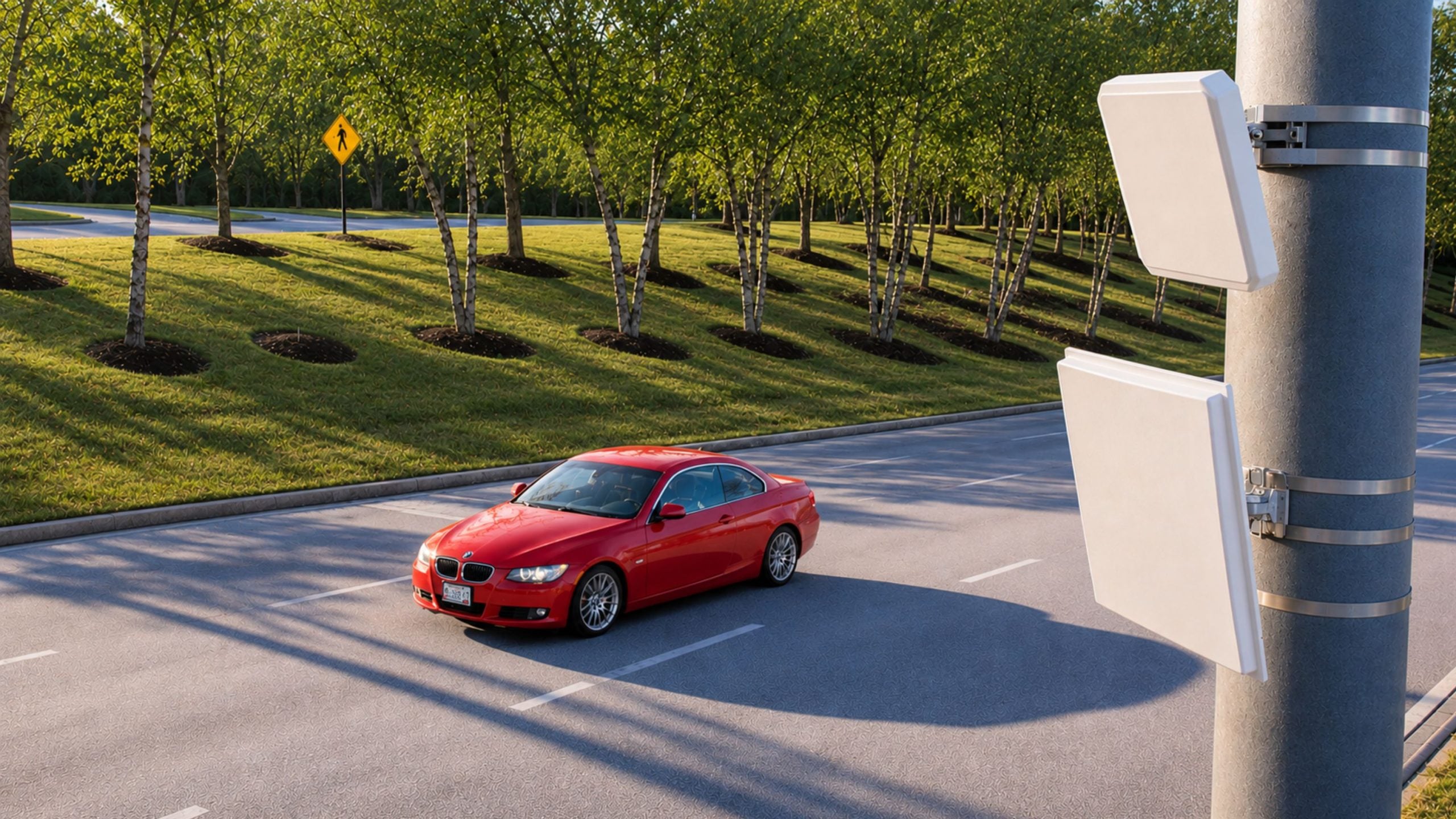
By Ken Macon
The newest thing in police surveillance is built on a simple insight about human nature, which is that criminals are careful about the wrong stuff.
A man trying to vanish from a license plate camera knows the routine. Swap the plate, the overpass reads a different number, the trail goes cold. What he does not do, on the same nervous morning, is also swap his earbuds, his watch, his fitness band, and the phone in his pocket.
SignalTrace is built around exactly that blind spot. The plate changes; the gadgets he carries every day do not, so the camera learns to recognize that cluster of devices and stops caring about the plate.
The company selling this is Leonardo US Cyber and Security Solutions, the American arm of the Italian defense conglomerate Leonardo S.p.A. Leonardo already sells one of the most widely deployed automatic license plate reader systems in the United States, under the ELSAG brand.
The cameras photographing tens of millions of American drivers every day, mostly without their knowledge, are in a lot of places already Leonardo’s.
SignalTrace is the upgrade they sell you to bolt onto the surveillance hardware you bought from them in the first place. You buy the camera that watches the car, then you buy the add-on that makes the camera watch the people in the car. It is the same vendor and the same overpass, billed twice.
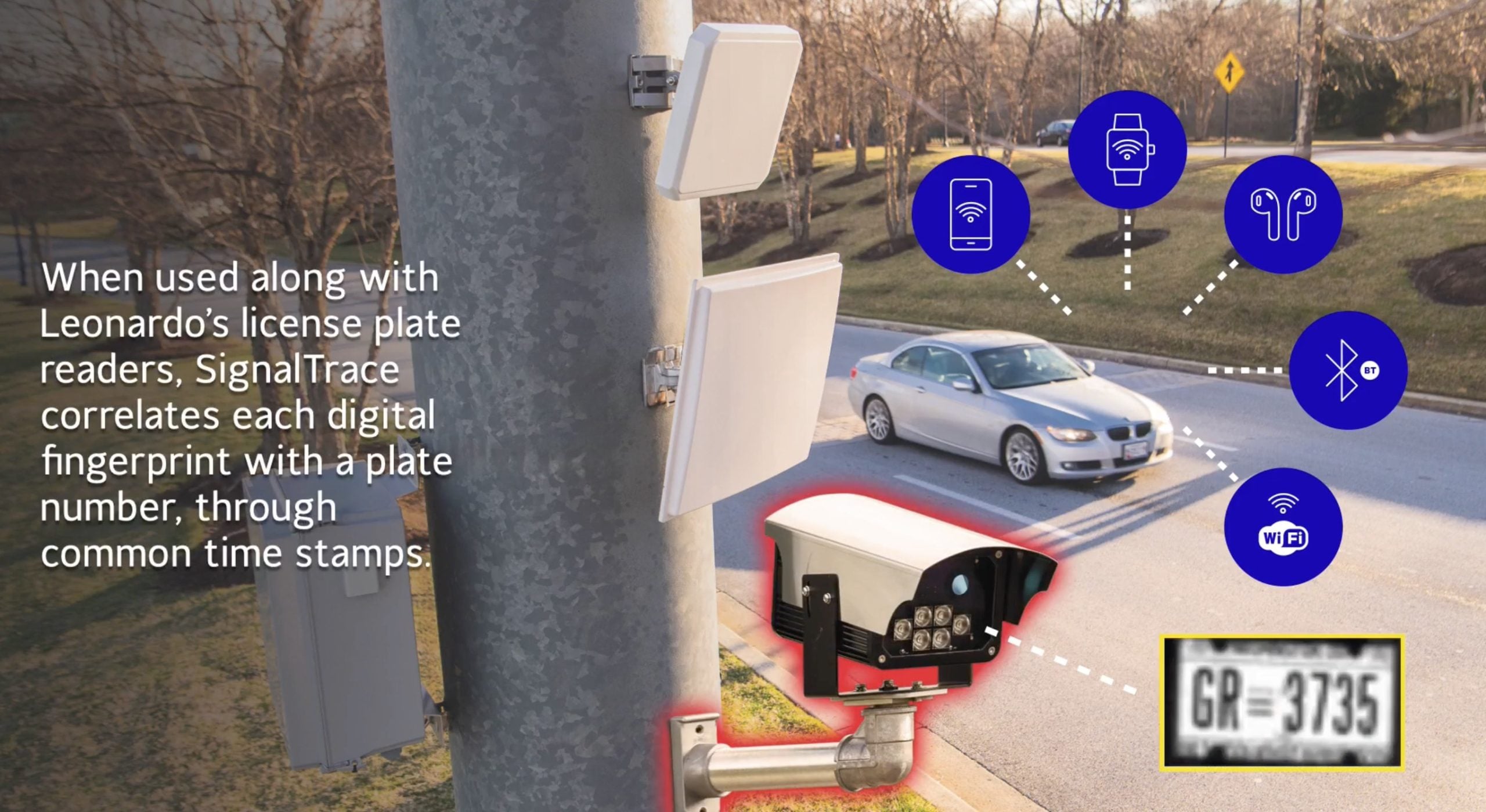
Reporter Joseph Cox of the technology outlet 404 Media detailed the product on June 8, 2026. According to Leonardo’s own materials, reviewed by 404 Media, the sensors sweep up the unique identifiers broadcast by anything nearby that emits a signal, including phones, Bluetooth wearables, RFID tags, Wi-Fi, and the electronic guts of the car itself.
Leonardo’s product sheet says the system pairs plate data with these captured identifiers to build a durable, trackable “electronic fingerprint.” The marketing copy is less coy about the point. SignalTrace lets police identify a suspect person or vehicle even when they don’t have the plate, by reading the signals leaking off the devices the person is wearing.
The product literature lists what it can read and the list keeps going past the point you would expect it to stop. The phone is obvious. So are the smartwatch, the wireless earbuds, the fitness tracker in the gym bag, the tire-pressure sensors in the wheels, and the AirTag clipped to a backpack.
Then, per the product sheet, comes the RFID chip implanted in the dog asleep on the back seat. The surveillance has reached the family pet. The system writes all of it down beside the plate and watches, over weeks, to see which of these little radios keep turning up together.
None of this is a hypothetical conjured to frighten you. It is a marketed product, and the company filed the paperwork to prove it means business.
Leonardo holds U.S. Patent 11,941,716 B2, titled “Systems and Methods for Electronic Signature Tracking,” granted in March 2024, and by 2025 the capability had a name and a sales pitch aimed at law enforcement.
Leonardo’s US operation also holds federal contracts, including with US Special Operations Command and the General Services Administration. The thing originally good enough for Special Operations Command is now available, in principle, to your county sheriff, who would like it for the shoplifters.
One caveat belongs here. No public record yet confirms a police department that has bought SignalTrace and turned it on. What is confirmed is smaller and worse for the long run: the capability is for sale, it bolts onto infrastructure that already covers the country, and nothing in current law stops a buyer from switching it on. The distance between a product on the shelf and a sensor pointed at your car is the width of a purchase order.
Your phone is trying. Your earbuds gave up.
The reason any of this functions comes down to a small fact about the gadgets you carry, which is that they almost never shut up.
For your phone to find your earbuds and your watch to sync with your phone, those devices fling tiny radio packets into the air several times a second, each one announcing that it exists and offering a name. This is Bluetooth Low Energy, the battery-sipping flavor of Bluetooth running most modern accessories, and those constant little announcements are precisely the raw material a roadside sensor scoops up.
The privacy hole here was obvious decades ago. If every device shouts a permanent serial number, its MAC address, then anyone with a cheap receiver can follow it around for life.
So phone makers built a defense. Modern iPhones and Android phones use address randomization, generating a temporary address and rotating it every few minutes instead of broadcasting the permanent one. To a sensor on the overpass, your phone is supposed to look like a parade of unrelated strangers rather than one trackable target.
It is a real protection and it leaks. In 2019, researchers at Boston University published a paper called Tracking Anonymized Bluetooth Devices showing how to walk straight around the randomization built to stop tracking.
The rotating address changes, but other identifying tokens buried in the broadcast sit still long enough to link one address to the next and recognize them as the same device. A separate study, Handoff All Your Privacy, from a team at MITRE and the US Naval Academy, found that Apple’s Continuity features broadcast unencrypted data, and that one macOS flaw defeated the randomization entirely by transmitting the true, permanent address.
The disguise, in other words, occasionally just tells you its real name.
So the phone’s protection is good and imperfect. The detail the headlines skip is that the phone is the device making any effort at all. Your accessories mostly are not. The Boston University team found that manufacturers have enormous freedom in how they handle Bluetooth privacy, or whether they bother, and plenty of cheap, low-power gadgets skip it to save battery.
Headphones, fitness bands, smart TVs, and bargain trackers advertise the same identifier on every trip, for years. They are not wearing a disguise. They are wearing a name tag. AirPods are the textbook case, famous for being easy to single out of a crowd.
It flips what most people assume about their own security. You can fortify the phone you think of as the spy in your pocket, the expensive one, the one with the privacy settings, and still get tracked with total reliability by the thirty-dollar earbuds you forgot were in your ears. The cops never needed the device you were worried about because the cheap one in your ear does the job.
The industry’s favorite alibi is being scrapped by the vendor
For years the plate-reader business has leaned on one reasonable-sounding line, which is that it tracks vehicles and not people. A license plate is a number the government issues for the express purpose of identifying a car in public. Photographing it, the argument runs, is no different from a cop on a corner writing it in a notebook, a thing courts have permitted without a warrant for a long time. It was a tidy defense and it held up for a while.
SignalTrace was built to take that defense apart. The privacy lobby did not force this. Leonardo did, by selling a product that only makes sense once the company stops pretending it tracks cars and not the people in them.
The whole pitch is bridging the car and the bodies inside it, converting a vehicle-tracking network into one that tracks people. The most damning witness against the old line is the company that used to recite it.
There was a dress rehearsal for this. In 2025, 404 revealed that Flock Safety, the dominant plate-reader company with cameras in more than 5,000 US communities, was building a tool called Nova designed to “jump from license plate reader to person.”
Nova matched a plate to an individual using data brokers, public records, and information lifted from data breaches, including a hacked parking app, which was apparently a step too far even for some Flock employees, who raised the ethics internally.
After the reporting and the staff revolt, Flock announced it would stop handing customers dark-web or hacked data.
What that victory amounted to was narrower than it sounded. Flock did not cancel Nova. It dropped one especially toxic piece after the public found out and kept the rest.
Nova matched plates to people through bought and stolen records, a different method from SignalTrace reading the signals people physically give off. The lesson cuts two ways. The drive to turn a plate into a person is now industry-wide and relentless, and public attention has, exactly once, embarrassed a company into walking back a piece of it. Scrutiny trimmed these systems. It has not stopped a single one.
The law is not ready, and a federal judge said so to your face
No federal statute forbids a roadside sensor from collecting the Bluetooth or RFID identifiers your devices broadcast. State plate-reader laws, where they bothered to write any, were drafted with photographs of plates in mind, not the wholesale harvesting of wireless signatures off everyone’s body. SignalTrace lives in the empty space between those two facts, which is a comfortable place for a surveillance product to live.
The constitutional fight runs through the Fourth Amendment and its ban on “unreasonable searches.” For decades the working theory was that anything you expose to the public, your face, your car, your plate on the road, carries no reasonable expectation of privacy, so watching it isn’t a search at all.
That theory cracked in Carpenter v. United States in 2018, when the Supreme Court ruled that police needed a warrant to pull a person’s historical cell-phone location records, because enough location points stitched together reveal “the whole of a person’s movements,” a private portrait the Constitution shields even though any single ping is boring on its own. A thousand public dots, assembled, can form a private picture.
Whether plate-reader networks cross that line is being argued right now in Schmidt v. City of Norfolk. Two Norfolk, Virginia residents, backed by the libertarian Institute for Justice, sued over the city’s web of Flock cameras after learning their cars had been photographed hundreds of times, one of them 475 times in four months.
In January 2026 a federal judge dismissed the case, ruling the 176-camera network constitutional because it was not extensive enough to track anyone continuously. The captures were minutes and miles apart, he reasoned, leaving gaps too big to reconstruct a routine. He also warned that the technology “could become too intrusive” and could run afoul of the Constitution “at some point,” before concluding that the line had not been crossed “in Norfolk, Virginia,” and “not today.”
The logic is strange when you follow it out. The ruling holds that the surveillance is constitutional as long as it is not yet good enough to be unconstitutional. Your privacy is riding on the technology’s current clumsiness, the gaps between cameras, the minutes and miles. SignalTrace exists to close exactly those gaps. The judge said “not today” about a system being upgraded for the express purpose of making “not today” expire.
The plaintiffs appealed to the Fourth Circuit, and in April 2026 an unlikely coalition of the ACLU, the Electronic Frontier Foundation, the Cato Institute, and EPIC filed briefs arguing the ruling reads modern surveillance exactly backward. Their point, leaning on Carpenter and on the Fourth Circuit’s own 2021 decision striking down Baltimore’s aerial-surveillance program in Leaders of a Beautiful Struggle v. Baltimore Police Department, is that a system able to deduce where you go, when, and with whom is a search even if a cop has to run a couple of extra queries to connect the dots.
Other courts have wandered the other way. A Washington appeals court in early 2026 rejected the comparison between plate readers and GPS tracking, calling plate-reading the functional equivalent of an officer noting a number by hand. The split is real and nobody has resolved it.
Now drop SignalTrace into that unsettled mess and you get the question privacy lawyers will be losing sleep over. The plate alibi always rested on a plate being a public number. So is the signal coming off the watch on your wrist more like a plate, a public thing you put on display, or more like you?
A plate is issued by the state and bolted to a car you chose to drive in public. The static address of your hearing aid or your insulin pump is none of those things. It is an involuntary broadcast from a machine strapped to your body, leaking your identity whether or not you have any idea it’s happening.
Decide it’s just another public signal and the logic that excuses plate-reading swallows the whole person. Decide it’s part of the body and SignalTrace is a warrantless search of everyone who drives past. No court has answered yet because the product is newer than the case law and the lawyers are still catching up.
Who actually bleeds for this
The case for tools like this deserves its strongest version, not a sneer. Police do not invent the need to find people. A suspect who keeps swapping stolen plates is a genuine headache, and so are abducted children, fugitives, and the organized retail-theft crews that plate-reader salesmen bring up in every meeting. Leonardo’s framing is reassuring on its face. The company says SignalTrace captures device signals without decrypting the contents of your communications, stores nothing until an investigator files a specific request, and logs user activity for auditing. We collect the identifiers, not your messages. Trust the audit log.
The trouble is that the documented history of this precise infrastructure has no interest in cooperating with that trust.
You can see this for yourself tonight. Apps like nRF Connect, on iOS and Android, and the open-source BLE Radar on Android turn your phone into a passive Bluetooth scanner. Open one in your parked car or on your own street and watch the invisible turn visible, your own earbuds by name, a neighbor’s TV, a fitness band drifting by on a runner’s wrist. Some identifiers keep changing as you move, doing their job.
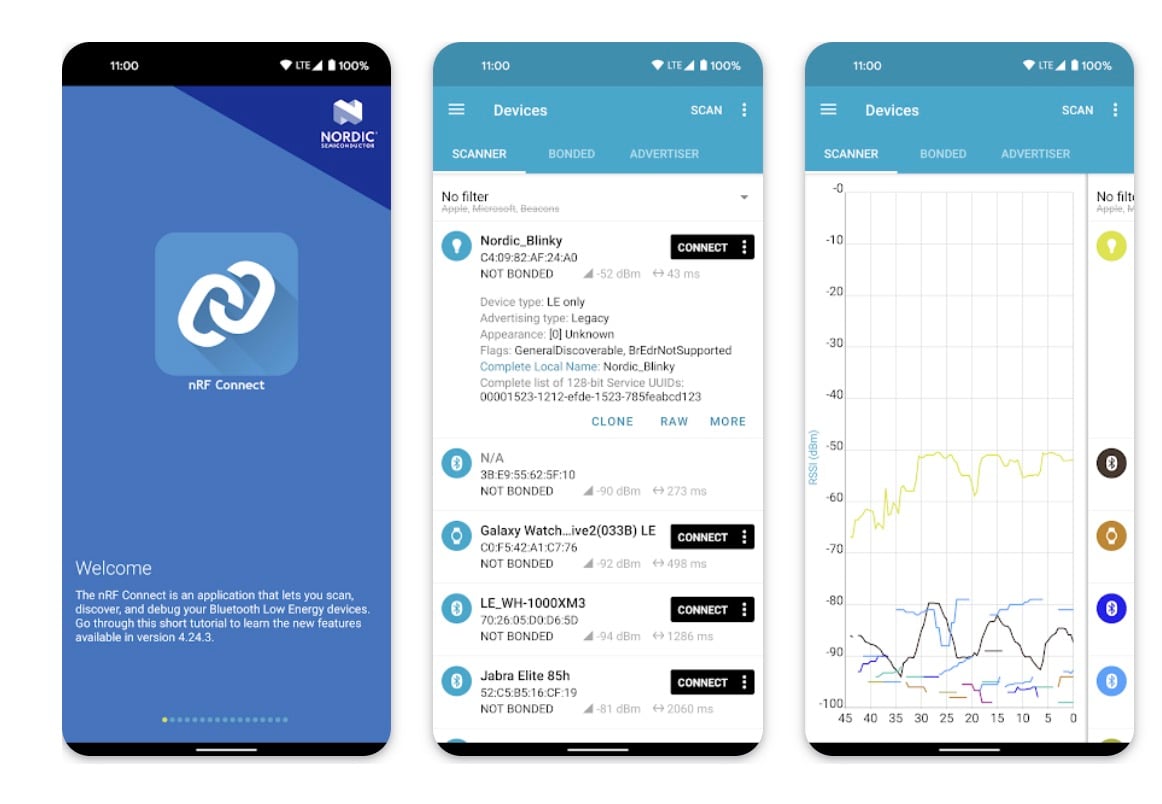
Others sit there broadcasting the same tag over and over, refusing to go dark. That stubborn signal is the one a roadside sensor recognizes on every trip. There are easy, if modest, things a person can do. Turning Bluetooth fully off, not merely tapping disconnect in the control panel, which on an iPhone leaves the radio running, actually shuts the phone up. Keeping firmware and operating systems updated helps more than it sounds, since the randomization fixes ride in on those updates. But the blunt fact under all of it is that babying your phone does nothing about the always-on accessories around you.
The earbuds in their case and the watch on your wrist keep broadcasting no matter what your phone is doing, and they are not in the settings menu you were just fiddling with. Like the cameras this bolts onto, it is infrastructure. You cannot opt out of a sensor on a public overpass by adjusting a toggle, any more than you can opt out of your license plate by feeling strongly about it.
So the remedy was never going to be in a settings menu, which is inconvenient, since that is the only place most of us are allowed to push back. The real fights are elsewhere. They’re in the Schmidt appeal now before the Fourth Circuit, where judges will decide whether the fingerprint off your wrist is a public plate or a piece of a person. They’re in newer challenges like the suit filed in San Jose in April 2026, testing whether AI-driven fingerprint tracking can survive constitutional review at all. They’re in the state legislatures that could require a warrant before police harvest the wireless signals of everyone who drives past, if any legislature decides to bother. And they’re in the procurement meetings of the more than 5,000 communities already hosting these cameras, where a city council can still ask whether the new sensor is worth it before signing, assuming anyone in the room knows to ask.
The Flock Nova situation proved that public attention can force a retreat, which is the closest thing to good news in this. SignalTrace shows you how the next round arrives. The product is on the shelf and, as far as anyone has confirmed, no department has turned it on yet. That last clause is the only part of this still up to anybody. It does not stay true on its own, and the company is counting on you finding the dog’s tracking chip too absurd to take seriously until it’s already in the wall.