

And this is why any centralized stablecoin is a non-starter, as you can be censored. And they can easily be turned into a government CBDC as well. Sure, today it’s unapproved illegal activity, but tomorrow it’s because you’re not vaccinated, drove too much, bought too much beef, posted online comments against the government… With Bitcoin, there is no way to censor except through government regulated off-ramps to fiat within your country’s borders. This won’t stop your ability to transact with Bitcoin with anyone around the world, or convert to cash with private parties. And you could covert to Monero and escape government tracking altogether… And with a VPN you can access anonymous exchanges around the world to convert to and from Bitcoin at will outside your government’s regulations and licensing.
By Naga Avan-Nomayo
Quick Take
- Tether said it supported the freeze of more than $344 million in USDT across two Tron addresses after U.S. authorities flagged the wallets for illicit activity.
- The firm said the action was taken in coordination with OFAC and U.S. law enforcement, though it did not identify the underlying case.
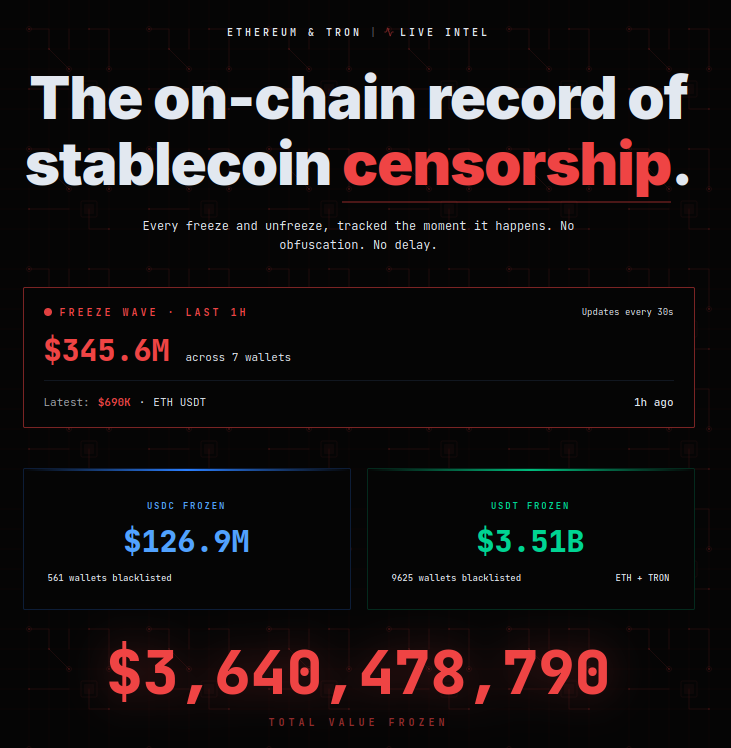
Tether said it supported the freeze of more than $344 million in USDT across two Tron addresses, confirming an earlier onchain blacklist action that appears to be one of the largest in the company’s history.
The stablecoin issuer said the freeze was carried out in coordination with the Office of Foreign Assets Control and U.S. law enforcement after authorities shared information tied to unlawful conduct.
In a Thursday notice, Tether did not identify the underlying investigation or say when the wallets were first flagged.
Blockchain security firm PeckShield had earlier said two Tron wallets — TNiq9…QZH81 and TTiDL…pjSr9 — were blacklisted on April 23. At the time, neither Tether nor Tron had publicly explained the move.
The two addresses were publicly visible on Tron explorers before the freeze, with one holding about $213 million in USDT and the other roughly $131 million, bringing the total to more than $344 million.
Tether said the action followed information linked to sanctions evasion, criminal networks, or other illicit activity. “USDT is not a safe haven for illicit activity,” CEO Paolo Ardoino said in the company’s statement, adding that Tether moves quickly when it identifies credible links to sanctioned entities or criminal actors.
The freeze is significant in two ways. It is reportedly the biggest one yet by size, and it fits a pattern Tether has leaned into more aggressively since late 2023.
Enforcement trend
The company also used the announcement to highlight its broader enforcement footprint.
Tether said it now works with more than 340 law enforcement agencies across 65 countries, has supported more than 2,300 cases globally, and has frozen more than $4.4 billion in assets overall, including more than $2.1 billion tied to U.S. authorities.
Back in November 2023, the company froze about $225 million in USDT linked to a Southeast Asia human-trafficking and “pig butchering” investigation. In January this year, it froze roughly $182 million across five Tron wallets in what it said was a law-enforcement-linked action.