

This is interesting, and could make the UAE and lot of money. I’d like to see volume analysis compared with expense to cargo, and how quickly it could be up and running. Consequently, the UAE is always of interest as I think the crown prince of Dubai is the coming Antichrist, with the seven emirates of the UAE being the seven heads of the Beast in Revelation…
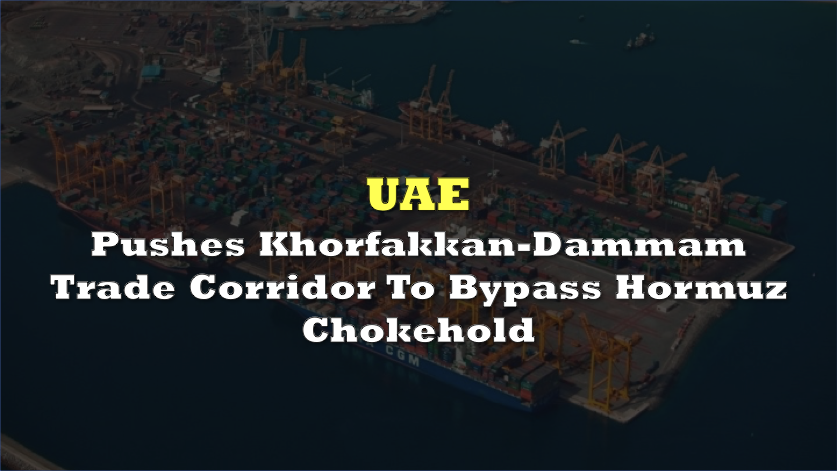
- The UAE’s push to route cargo through Khorfakkan and onward to Saudi Arabia is a logistics hedge against Hormuz disruption that targets not just energy risk, but the Gulf’s broader dependence on imported essentials.
By ER Velasco
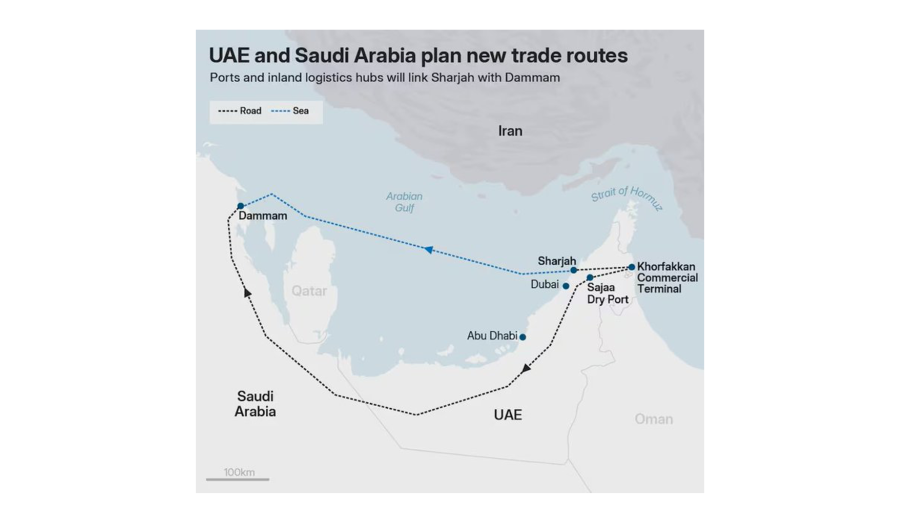
The UAE is advancing a Sharjah-to-Saudi trade corridor that would reroute cargo around the Strait of Hormuz, shifting part of Gulf logistics toward the Gulf of Oman and reducing dependence on a chokepoint that handles roughly 20% of global oil trade.
The corridor centres on Khorfakkan, a port in Sharjah positioned outside the Strait on the Indian Ocean side of the UAE. The location allows vessels to discharge cargo without entering the Gulf at all.
In practical terms, that gives the UAE a rare geographic advantage among Gulf states. It is the only Gulf country with coastlines both behind the Strait on the Persian Gulf and outside it on the Gulf of Oman.
The proposed route would move goods arriving at Khorfakkan across UAE territory and onward into Saudi Arabia, ultimately linking with logistics networks serving Dammam, the kingdom’s eastern commercial hub.
The Strait of Hormuz is one of the world’s most sensitive maritime chokepoints, and any disruption there affects more than crude exports. A blockage constrains oil and gas leaving the Gulf, but it also impedes food and other essential goods entering it.
Khorfakkan’s role in the contingency planning has grown because the port is already a meaningful container hub and has been expanded in recent years to handle larger ships and higher cargo volumes. Those upgrades increase its utility not just as a domestic port asset, but as a regional fallback node.
No official timeline has been announced, which limits visibility into execution speed and near-term capacity.